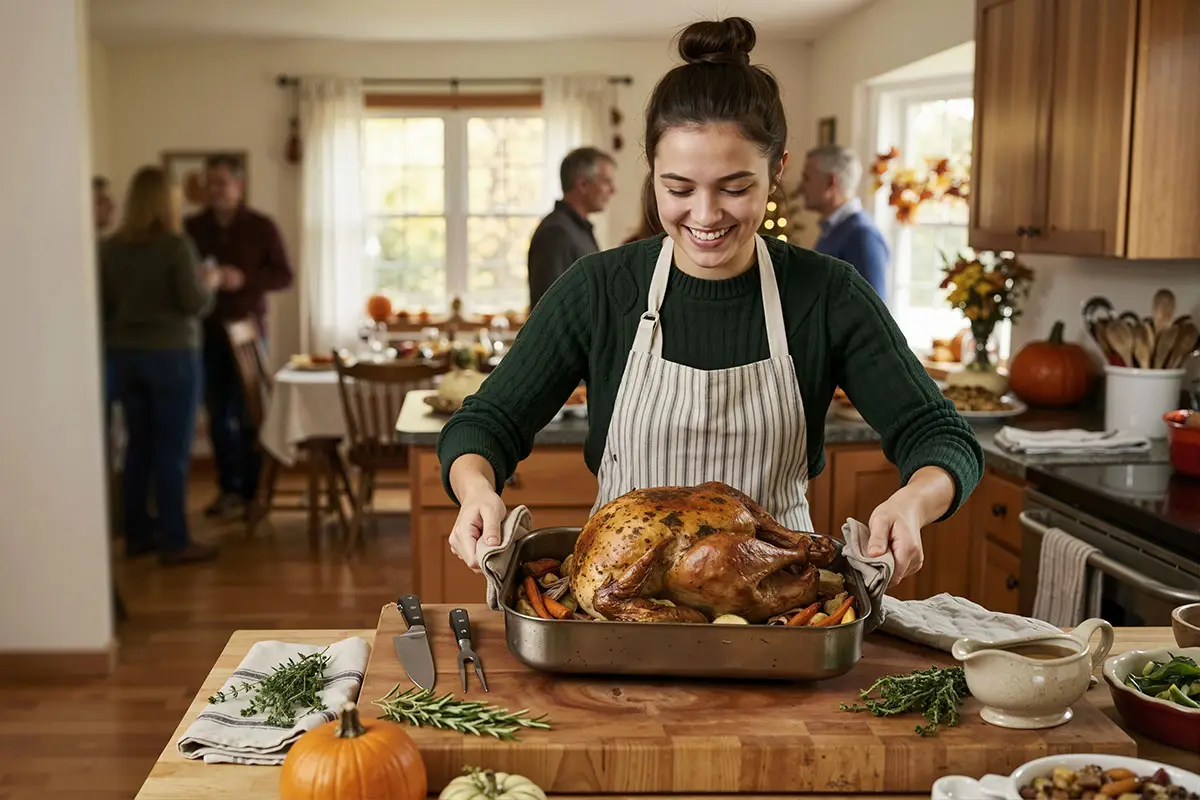
There is a moment every Thanksgiving, usually somewhere between the second glass of wine and the moment someone burns a crescent roll, when the table looks exactly the way it always has. The green bean casserole bubbling at one end. The cranberry sauce catching the light in its dish. The turkey anchoring the center of everything, golden and inevitable. It all feels ancient, like it could not have happened any other way.
But here is the thing: almost none of it was planned.
Dishes that feel most woven into the fabric of American Thanksgiving, ones that spark the warmest debates and the strongest childhood memories, did not descend from centuries of tradition. They were invented by accident. By women in test kitchens trying to sell cans of soup. By a cranberry farmer who had more product than he could move. By a Chicago PR executive who thought a hotline might be a good idea.
These are their stories.
The Casserole That Came From a Can
In 1955, a young home economist named Dorcas Reilly showed up for work at the Campbell Soup Company’s test kitchen in Camden, New Jersey. The same city where she had grown up, not far from the brick towers where the soup was made. She had studied at Drexel, spent a few years teaching homemakers how to use electric stoves, and landed what she later called “paradise.” A job where every day meant inventing something new with food.
That year, an Associated Press food reporter came calling. She wanted a simple side dish recipe, something using common pantry ingredients that home cooks across America could actually pull off. Reilly’s team got to work. They tested canned lima beans, peas, corn, mixed vegetables. They stirred and tasted and started over. And then they tried canned cut green beans.
The final recipe was almost embarrassingly easy. Green beans, cream of mushroom soup, a splash of soy sauce, a little milk, and fried onions on top. Ten minutes of prep, 45 in the oven. Reilly called it the “Green Bean Bake.” The Associated Press ran it nationally. It had no connection to Thanksgiving at all.
That connection came later, quietly, when Campbell’s printed the recipe on the label of its cream of mushroom soup cans. Thanksgiving being the one meal a year when home cooks reached deepest into the pantry, the dish started appearing on holiday tables. It was renamed “green bean casserole.” And somehow, without ceremony or announcement, it became something many people could imagine the holiday without.
Today, 67% of Americans say the green bean casserole reminds them of Thanksgiving. 51% say the table would feel incomplete without it. 20 million casseroles are made each year during the holiday season. When Campbell’s asked Dorcas Reilly what she thought of all this, she answered the way you would expect someone to answer who had spent a career making food that made people happy: “It was very delicious and easy to prepare,” she said. “And it was made with things you already had in your pantry.”
In 2002, Reilly and Campbell’s donated her original handwritten recipe card to the National Inventors Hall of Fame. It sits there alongside turbine engines and fiber optics, a battered index card with a list of humble ingredients that somehow became a piece of American cultural history. She passed away in 2018, but her casserole remains, bubbling faithfully on tables from Maine to California every November.
The Bog That Became a Brand
The cranberry has been part of American Thanksgiving since the beginning. The Wampanoag people had been harvesting the tart red berries of coastal Massachusetts for centuries, and the first colonists learned quickly that nothing cut through a heavy autumn meal quite like that burst of tartness. But for most of American history, cranberries were a fresh, seasonal luxury. You got them in autumn, in a small window, and then they were gone.
That changed because of a man named Marcus Urann.
Urann was a lawyer who had made the unusual decision to become a cranberry farmer in coastal Massachusetts. By 1912, he was sitting on a surplus he could not sell and a harvest season that lasted only a few weeks. So he started cooking cranberries down into a thick sauce and sealing them in tin cans. The canned cranberry sauce could be shipped anywhere, stored all year, and opened on a moment’s notice. For the first time, cranberries could come to the table whenever they were wanted.
Urann was entrepreneurial, but he was also smart enough to know he could not do it alone. He approached two of his competitors, John Makepeace and Elizabeth Lee (a cranberry grower from New Jersey), and he pitched them on forming a cooperative. Together they could standardize quality, control supply, and market to a national audience. The three agreed. In 1930, their cooperative, eventually renamed the National Cranberry Association, took the name it carries today: Ocean Spray.
The cooperative grew. The brand grew. And canned cranberry sauce became a fixture on the Thanksgiving table the way green bean casserole would a generation later. Not through a single dramatic moment, but through the slow accumulation of a million family meals. Americans now eat roughly 400 million pounds of cranberries a year, with the highest concentration coming right at the holidays.
And then, in September 2020, something unexpected happened.
A man named Nathan Apodaca posted a TikTok video of himself longboarding down a highway in Idaho, sipping Ocean Spray Cran-Raspberry juice straight from the bottle, and vibing to Fleetwood Mac’s “Dreams.” He had not been paid. He was not a brand ambassador. His truck had broken down and he was just trying to get to work. The video hit 60 million views. “Dreams” re-entered the charts. And Ocean Spray, a 90-year-old cranberry cooperative born out of surplus and survival, found itself at the center of one of the most viral marketing moments of the decade.
The company sent Nathan Apodaca a brand-new truck, loaded with Ocean Spray juice. He drove it off the lot with a bottle in hand.
Marcus Urann, who cooked his surplus cranberries into something that could last, he probably could not have imagined that moment. But it felt, somehow, exactly like the brand he built.
The Phone Line That Talked a Nation Through Its Greatest Cooking Challenge
In 1981, a Chicago public relations executive named Pam Talbot had an idea.
The turkey, she understood, was the most intimidating centerpiece in American cooking. It was cooked once a year, by people who had watched it done but never quite trusted themselves to do it. It thawed wrong or not at all. It cooked unevenly. It was perpetually threatened by many factors such as the dog, the snowbank where it had been left to thaw and subsequently lost, and the well-meaning relative who had already pre-salted it. Every November, across the country, people stood in front of a raw turkey and thought, “I need help.”
Talbot pitched Butterball on a toll-free hotline staffed by home economists who could answer those questions in real time. The company said yes. The Butterball Turkey Talk-Line launched that year with six operators, a small notebook, and a stack of binders. In its first season, it answered 11,000 calls.
That number grew. It kept growing. The staff grew with it, and the operators who joined tended to stay, many for over 20 years. Their openings filled mostly by word of mouth, one culinary expert passing the job to the next. Today, more than 50 experts staff the line from November 1 through December 24, out of Butterball’s offices in Naperville, Illinois, fielding over 100,000 questions every holiday season.
Most of the calls are about thawing, the perennial stumbling block, the question the chart on Butterball’s website exists to answer. But a remarkable percentage of the calls are something else entirely. They are the calls that have made the Turkey Talk-Line something more than a marketing campaign. It has become a small window into the full, messy, tender reality of the American holiday kitchen.
There was the truck driver who wanted to know if he could cook his turkey on the engine block of his semi while he was driving. The caller who had left the bird in a snowbank to thaw and could not find it anymore. The person who called to report that the family dog had gotten its head inside the turkey and could not get it out. The would-be innovator who wondered if suntan lotion might work as a basting agent.
The operators answered them all. Patiently, warmly, without judgment.
In 2013, Butterball hired its first male operator. Until then, every voice on the line had been a woman’s. In 2018, the line integrated with Amazon Alexa, so a home cook with her hands covered in butter could ask for help without touching her phone. Through it all, Butterball senior brand manager Rebecca Welch noted, the operators do something beyond culinary guidance: they offer emotional support. The person on the other end of the line is often not panicking about the turkey, they are panicking about the whole meal, the whole gathering, everything the day is supposed to mean.
The New York Times once called the Turkey Talk-Line “one of the great marketing ideas of modern American consumerism.” That is true. It is also just a phone number you can call when you are scared of a bird that is bigger than your largest pot, and a calm voice will help you figure it out.
What These Stories Have in Common
None of these things were meant to be traditions.
The green bean casserole was a recipe developed in a test kitchen to sell soup, with no holiday in mind. The cranberry sauce in a can was a surplus problem in search of a solution. The Turkey Talk-Line was a PR pitch from someone who noticed a gap, a nation of home cooks standing alone in front of a 20-pound bird every November, hoping for the best.
What made them last was something simpler: they were genuinely useful. They solved real problems, met real needs, and arrived at the table without pretension. Dorcas Reilly made something easy and delicious from whatever you already had. Marcus Urann made the tart berry of autumn available any time of year. Pam Talbot made sure no one had to face Thanksgiving morning alone.
That is what happens when a good idea meets the right moment. It does not feel like marketing anymore. It just feels like home.
This Thanksgiving, as you are passing the casserole dish and reaching for the cranberry sauce and silently thanking whoever it is that answers the turkey hotline, take a second to appreciate what you are sitting in the middle of. Not just a meal. A collection of accidental masterpieces, made by people who were just trying to get it right.
Happy Thanksgiving from all of us at Resolution Promotions. May your table be full, your turkey golden, and your casserole bubbling exactly the way it always has.
Resolution Promotions is a full-service marketing and promotions agency based in Brick, NJ, helping brands tell stories that connect.