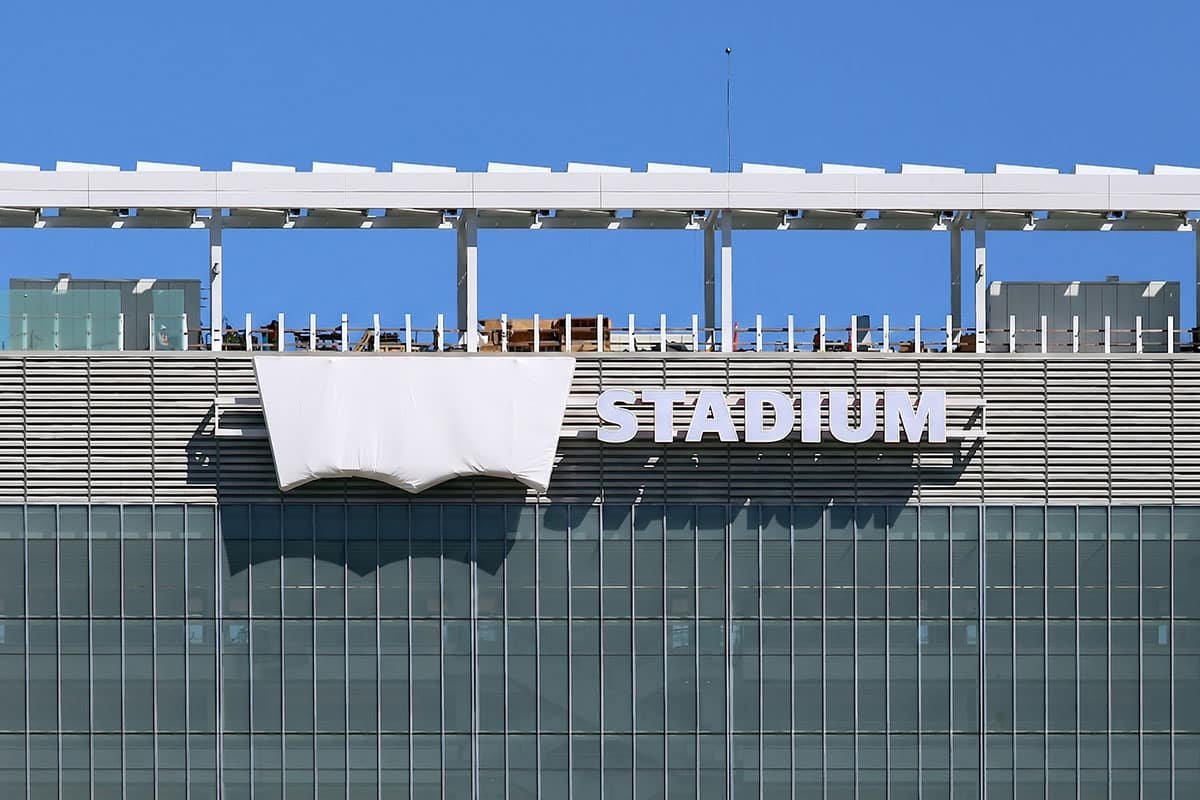
Recently in Santa Clara, California, a work crew spent part of June draping a giant white tarp over the side of a football stadium.
The stadium is called Levi’s Stadium. It has been called that since it opened in 2014, home to the San Francisco 49ers and, this summer, six matches of the 2026 FIFA World Cup. But FIFA’s rules are absolute: no venue branding from a company that is not an official tournament sponsor. Levi’s is not an official sponsor. So for the duration of the tournament, the stadium became “San Francisco Bay Area Stadium,” and the Levi’s name and logo disappeared under a sheet of white fabric.
Except it did not really disappear. The shape underneath the tarp, that unmistakable batwing silhouette stitched into the back pocket of every pair of Levi’s jeans since 1936, was still completely recognizable. FIFA had covered the name. They had not covered the idea of the name. And the moment fans noticed, the joke wrote itself.
Levi’s noticed, too, and reacted within hours. The brand changed its social media profile photos across platforms to mimic the covered logo. It posted videos covering its own red tabs and signage in the same white fabric, leaning all the way into the bit rather than fighting it. One TikTok caption read simply: free @Levi’s. The posts generated millions of views. Comments poured in calling it a “branding masterclass.” One person wrote that the marketing was so good, it convinced them to buy their first brand-new pair of Levi’s jeans in years.
FIFA tried to make Levi’s invisible. Instead, they made Levi’s the single most talked-about brand of the tournament’s opening weeks, without Levi’s spending a dollar on an official sponsorship. It is one of the cleanest examples in recent memory of a very old and very reliable marketing principle: sometimes the obstacle is the opportunity, if you are fast enough and confident enough to see it.
Then FIFA Came for the Condiments
If the Levi’s story were the only one, it might read as a lucky accident. However, it was not the only one.
In the press box of that same rebranded stadium, FIFA’s clean-venue enforcement reached an almost absurd level of thoroughness. Workers were dispatched to tape over the labels on condiment bottles (Heinz ketchup, Hellmann’s mayonnaise, Tabasco hot sauce) sitting on a table next to the hot dogs and hamburgers, because none of those brands held official World Cup sponsorship rights. Photos of the blacked-out bottles spread quickly online, with fans joking that the bottles looked more thoroughly redacted than a government document.
Heinz did not wait for the joke to pass. The brand released its own version of the moment, a ketchup bottle deliberately designed to comply with FIFA’s rules, leaning into the absurdity rather than complaining about it. Heineken, meanwhile, ran a separate campaign pairing six bottles of beer with one bottle of Heinz ketchup standing in the lineup, a generic football nod that stayed just inside FIFA’s brand guidelines while still making its point. None of these campaigns broke a single rule. All of them generated more attention than a compliant, invisible condiment bottle ever would have on its own.
A marketing creative director watching it all unfold put it simply: brands today are so well-conditioned to react and adapt in real time that the era of strict, top-down brand protection is, in some sense, missing the point. Covering a logo in a culture this fast-moving and this online does not make the brand disappear. It makes the cover-up the story, and the brand that handles that story with confidence and humor usually comes out ahead of where it started.
This Is Not a New Trick. It Has a Decades-Long History.
What Levi’s and Heinz pulled off in 2026 has a name in the marketing world: ambush marketing. The term was coined in the 1980s by Jerry Welsh, a marketing strategist working on American Express’s campaigns. And the practice has been refined into something close to an art form ever since, especially around events like the Olympics and the World Cup, where official sponsorship can cost upward of 200 million dollars, and the non-sponsors have every incentive to find a way in anyway.
The single most famous case study happened at the 1996 Atlanta Olympics, and it set the template that every brand attempting this move has been studying ever since. Reebok had paid a reported 50 million dollars to become the official Olympic sportswear sponsor. Nike paid nothing, and proceeded to dominate the conversation anyway. The company plastered Atlanta with billboards near the Olympic Village, handed out thousands of Nike-branded flags to fans in the stands, and opened an oversized “Nike Centre” right beside the athletes’ village. Then sprinter Michael Johnson won the 400-meter gold medal wearing a pair of custom gold Nike spikes that cost a reported 30 thousand dollars to produce. The image of those gold shoes ran on the cover of Time magazine days later. Post-Games polling found that more consumers believed Nike was the official Olympic sponsor than believed it was Reebok, the company that had actually paid for the title.
The Atlanta ambush was so effective that it permanently changed how the Olympics and other major sporting bodies protect their sponsors. It is also, not coincidentally, the same instinct FIFA was trying to defend against 30 years later with a roll of white tape in a stadium press box. And the same instinct that, once again, the brand on the receiving end of the restriction turned into a win.
Paddy Power, the Irish betting company, has built an entire brand identity around this exact maneuver. Ahead of the 2012 London Olympics, with strict laws in place to prevent any non-sponsor from referencing the Games, Paddy Power put up billboards across London declaring itself the “official sponsor of the largest athletics event in London this year.” The fine print revealed the punchline: they were referring to an egg-and-spoon race in a small village called London, located in France. Olympic organizers were furious and ordered the billboards removed. Paddy Power threatened to fight the takedown in court, the organizers backed off, and the brand got weeks of free press out of a stunt that, technically, broke no rules at all. Two years later, at Euro 2012, the same company paid a Danish footballer’s fine after he dropped his shorts mid-celebration to reveal Paddy Power-branded underwear to a television audience of more than 100 million people, and called it good value for the exposure.
The Pattern Underneath All of These Stories
Lay all of these moments side by side (Nike’s gold shoes in 1996, Paddy Power’s egg-and-spoon race in 2012, Levi’s tarp and Heinz’s redacted condiments in 2026), and a consistent shape emerges. None of these brands created the obstacle. The obstacle was imposed on them by a third party with its own legitimate interest in protecting paying sponsors. What separated these brands from every other company that got the same restriction and simply complied quietly was speed, confidence, and a willingness to let the audience in on the joke rather than treating the restriction as a problem to manage privately.
The Levi’s response specifically offers a clean blueprint, because the company did almost nothing expensive. Nobody commissioned a multi-million-dollar campaign. The social team changed a profile picture, filmed a few quick videos with a white sheet, and let the existing visual recognition of the batwing logo do the actual work. The brand’s identity was strong enough, after nearly 90 years of consistent visual presence, that even a deliberate attempt to erase it from public view could not actually make it disappear. That is the deeper lesson sitting underneath the joke: this kind of moment is only available to a brand whose identity is already strong enough to survive being partially covered up. A weaker, less distinctive brand could have been hidden behind that same tarp and genuinely vanished from the conversation.
Timing was the other non-negotiable ingredient. Every one of these stories worked because the brand reacted inside the same news cycle the obstacle created. They responded in hours, not weeks. Marketing experts who track these moments are explicit about this. The press cycle in 2026 moves in hours, fragmented across a dozen platforms simultaneously. A brilliant response to a viral moment, published two weeks later after a round of internal approvals, is not a response. It is a missed opportunity wearing the costume of caution.
The Moment That Cost Nothing and Beat Every Sponsor Anyway
If Levi’s and Heinz prove that a strong existing brand can turn a restriction into a win, a completely different story from the same tournament proves the principle scales down even further than that, all the way down to zero budget and zero brand at all.
In Amarillo, Texas, a man in a cowboy hat walked up to three strangers at a bar (tourists who had flown in from Europe for the tournament) and bought their round without introducing himself. He shook their hands, asked where they were from, then walked away and came back a few minutes later with a heavy-duty pin from the local police department, a small gift for visitors he would likely never see again. One of the Europeans had a phone out. The video went online. It was one of dozens shot the same way, by different European visitors, in different cities, encountering the same kind of unscripted, unpaid hospitality. And collectively they outperformed almost every official campaign FIFA’s actual sponsors spent millions producing.
Nothing about that moment was a marketing tactic in the traditional sense. Nobody briefed the man in the cowboy hat. No agency storyboarded the handshake. It worked precisely because it could not have been manufactured, and that is the same underlying truth sitting beneath the Levi’s tarp and the Heinz bottles, just stripped down to its rawest form. Genuine character, captured in a real moment, travels further than anything built specifically to be shared. The brands and the bar patrons who win these moments are not the ones with the biggest production budget. They are the ones who show up, in public, as exactly who they already are, and let someone else’s camera do the rest.
What This Actually Means for a Business That Is Not Levi’s
It would be easy to read this story as something that only applies to global brands with World Cup-level visibility and a legal team on retainer. The underlying instinct scales down much further than that.
Every business, at some point, runs into a version of this same situation: a rule it did not write, a restriction it did not ask for, a setback that was not its fault. A platform changes its algorithm overnight. A permit gets denied for an event that was already promoted. A competitor undercuts a price the week before a big local promotion. A venue cancels a booking with no warning. The instinct in almost every one of these situations is to treat the obstacle as something to quietly absorb and move past. Fix it internally, apologize if needed, and hope nobody noticed.
The Levi’s and Heinz playbook suggests a different default question worth asking first: is there a way to let people in on what just happened, with enough humor and confidence that the obstacle itself becomes more interesting than if it had never occurred? That does not mean every setback deserves a joke. There is a real difference between a denied permit and, say, a genuine service failure that hurt a customer. But for the category of problem that is mostly annoying rather than damaging (a rule, a restriction, an inconvenience imposed from outside), the businesses that respond with transparency and a sense of humor consistently outperform the ones that respond with silence or a defensive statement.
It also requires the same prerequisite that made Levi’s tarp moment work: a brand identity distinct enough to survive being covered up. That is not built during the crisis. It is built in the months and years beforehand, through consistent visual identity, a clear voice, and a track record that gives an audience something to recognize the moment a silhouette appears under a sheet. The brands that can pull off this kind of moment earned the right to it long before the obstacle ever showed up.
Key Takeaways
- The obstacle is sometimes the opportunity. FIFA’s attempt to hide Levi’s branding generated more attention for the brand than leaving the logo untouched ever would have. A restriction handled with confidence can outperform the thing it was meant to suppress.
- Speed is the non-negotiable ingredient. Every example in this story (Nike in 1996, Paddy Power in 2012, Levi’s and Heinz in 2026) worked because the brand responded within the same news cycle the obstacle created. A great reactive idea published weeks late is not reactive anymore.
- This only works if the underlying brand identity is already strong. Levi’s batwing logo was recognizable even under a tarp because the shape had been consistent for 90 years. A less distinctive brand covered the same way would have genuinely disappeared. The moment does not build the brand, it reveals one that was already built.
- Letting the audience in on the joke beats a defensive statement. Heinz did not complain about the tape on its condiment bottles. It made its own version of the joke. Transparency and humor, applied to a genuine but minor inconvenience, consistently outperform silence or corporate defensiveness.
- This works at zero budget, too. A man buying strangers a round of beers in a Texas bar, with no brand and no brief, generated more genuine engagement than many official sponsor campaigns. Authentic character in a real moment is the actual asset. Money and logos are optional.
- Not every setback deserves this treatment. The Levi’s playbook applies to rules, restrictions, and inconveniences imposed from outside, not to genuine mistakes or service failures that actually hurt a customer. Knowing the difference is part of using this tool well.
FAQs About Ambush Marketing
Is what Levi’s and Heinz did during the 2026 World Cup legal?
Yes. Both brands complied fully with FIFA’s clean-venue rules. Levi’s covered its stadium branding as required, and Heinz’s bottles were covered as instructed. What both brands did afterward was market their own compliance: posting about the experience on their own channels, using their own assets, without referencing FIFA’s protected trademarks or implying any official tournament sponsorship. This is the core distinction in ambush marketing. There is a meaningful difference between unlawfully implying a false sponsorship and lawfully commenting, with humor, on a real situation a brand found itself in. The safest version, and the one both brands used here, simply tells the truth about what happened in an entertaining way.
What is ambush marketing, and is it always allowed?
Ambush marketing refers to a brand associating itself with the prominence of a major event without paying for official sponsorship rights. It is not automatically illegal, but it exists on a spectrum. Tactics that imply a false sponsorship, misuse protected trademarks, or actively mislead consumers into believing a brand is officially affiliated can create real legal exposure. Tactics that simply reference the cultural moment in generic terms, or that comment honestly on a brand’s own real experience (like Levi’s covered logo or Heinz’s taped-over bottles) sit on much safer ground. Event organizers like FIFA and the IOC have grown increasingly sophisticated at policing the riskier end of this spectrum, which is part of why the safest and most effective modern ambush campaigns tend to be honest, fast, and a little self-deprecating rather than aggressive.
How can a small business apply this kind of thinking without a global marketing team?
The scale is different, but the instinct is identical. And it does not require a budget. When something genuinely annoying but minor happens to a small business (a permit delay, a supply hiccup, a competitor’s stunt, an unexpected rule change), the first question worth asking is whether there is an honest, slightly funny way to bring customers into the moment rather than hiding it. A short social post explaining the situation with personality, rather than silence or a formal statement, almost always performs better and costs nothing beyond a few minutes of someone’s attention. The prerequisite is the same at any scale. A business needs a recognizable voice and identity before this kind of moment can work, which is exactly why building a consistent brand presence matters long before any specific obstacle ever shows up.
At Resolution Promotions, we believe the best marketing moments are often the ones nobody planned for, if your brand has the identity and the speed to seize them. If you are ready to build that kind of brand, let’s talk.