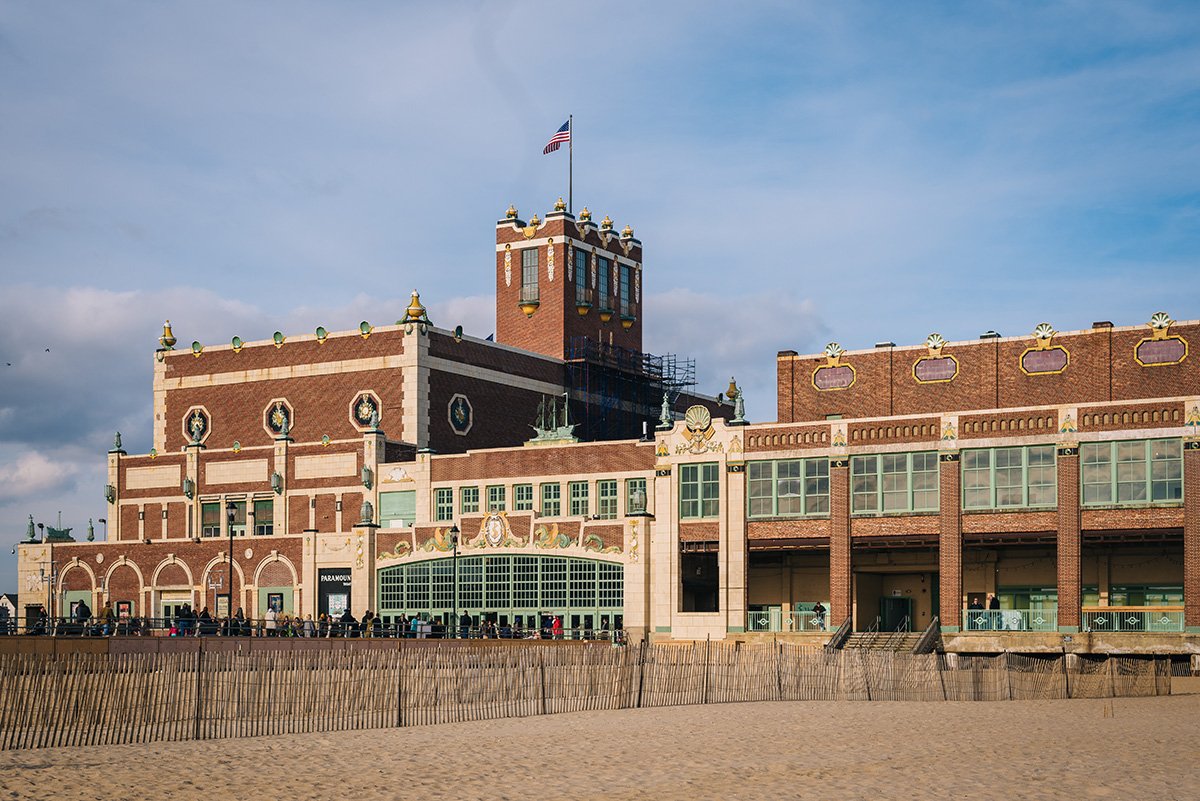
On the evening of August 16, 1969, Led Zeppelin played the Asbury Park Convention Hall. They had been invited to Woodstock that same weekend. Their manager, Peter Grant, turned it down because he did not think the festival would amount to much. So while half a million people gathered in a muddy field in upstate New York for what would become the defining cultural event of a generation, Led Zeppelin played a 3,600-seat arena on a boardwalk in New Jersey.
That is the kind of story Asbury Park Convention Hall has been accumulating since it opened in 1930. Specific, improbable, impossible to make up. Frank Sinatra sang there. The Rolling Stones played there. Elton John, James Brown, the Doors, Janis Joplin. A teenage Bruce Springsteen sat in the audience watching all of them before he became the one everyone came to see. President Obama stood on its stage. The sign on the roof now reads “Greetings from Asbury Park” (a reference to Springsteen’s 1973 debut album), facing west toward Bradley Park and visible from blocks away.
For the past five years, the building has been closed. Safety concerns forced the city to shut Convention Hall and the Paramount Theatre in 2021, and the complex has sat dark on the Asbury Park Boardwalk ever since. A ghost of something magnificent, waiting.
The waiting has finally moved meaningfully closer to an end. Just over a week ago, the New Jersey Economic Development Authority approved $75 million in Cultural Arts Facilities Expansion Program tax credits to support a $130 million restoration of the Convention Hall complex. Developer Madison Marquette, which has operated the Asbury Park boardwalk since 2007, has the funding framework it needs to bring one of the Jersey Shore’s most important buildings back to life.
Built on the Beach: The Origins of a Jersey Shore Institution
Asbury Park in the late 1920s was one of the most ambitious resort cities on the East Coast. Founded by James A. Bradley in 1871 as a planned, morally upright seaside community (no alcohol, strict ordinances, a deliberate counterpoint to the rougher resort towns nearby), it had grown into a genuine destination. Grand hotels, a bustling boardwalk, a summer social scene that drew visitors from New York and Philadelphia by the trainload.
The city wanted something that would anchor the boardwalk as a year-round cultural destination, not just a summer playground. It commissioned the architectural firm Warren and Wetmore (the same firm that designed Grand Central Terminal in New York City) to design a convention and entertainment complex on the beachfront. Construction began in 1928. The complex that emerged when it opened in 1930 was striking. Convention Hall itself, a Spanish Renaissance structure with a red tile roof, extending directly over the beach on pilings driven into the sand. Adjacent to it, connected by a covered Grand Arcade, sat the Paramount Theatre, an ornate 1,600-seat venue designed specifically for theatrical and musical performances. Both buildings were listed on the National Register of Historic Places.
The first official event held at Convention Hall was the annual meeting of the New York Friars’ Club. The building was wired for radio from the start, which was a remarkable forward-thinking decision. And by 1931 an AM radio station had moved its studios into Convention Hall, broadcasting live performances to listeners across the region. The complex was, from its earliest days, designed to be the cultural center of the Jersey Shore. For decades, it delivered on that ambition completely.
The Stage That Sinatra, Springsteen, and Zeppelin All Called Home
To understand what Convention Hall meant to the Jersey Shore, and to American music, you have to understand the era it occupied.
Through the 1940s, 1950s, and into the rock and roll revolution of the 1960s, the Convention Hall complex was one of the premier entertainment venues on the Eastern Seaboard. Frank Sinatra played the Paramount stage when he was still young enough to make teenage girls faint. James Brown performed there. The Doors. Janis Joplin. Elton John. The Rolling Stones. Acts that defined the century passed through a building on a boardwalk in Monmouth County, New Jersey, and the audiences that filled those seats were witnesses to something they probably did not fully appreciate at the time.
One of those audience members, in the 1960s, was a kid from Freehold named Bruce Springsteen. He watched the Who perform there. He saw the Doors. He absorbed the energy of that stage from the floor of a building that would later become his own. When Springsteen became the defining musical voice of the Jersey Shore, when he wrote the songs that would make Asbury Park famous to people who had never driven down the Garden State Parkway, he brought those memories with him. Convention Hall became his rehearsal space for major tours. He held ticketed public rehearsal shows there, gave fans early access to albums, and hosted Christmas concerts. The large illuminated sign on the roof that now reads “Greetings from Asbury Park” is a tribute to him, and to the album that put this city on the cultural map of a generation.
In June 1956, a concert by Frankie Lymon and the Teenagers ended in a riot. Three people were stabbed, and the mayor threatened a city-wide ban on rock and roll that mercifully never materialized. In August 1969, Led Zeppelin played the hall the same weekend they turned down Woodstock. In 2013, President Obama stood on the Convention Hall stage during a post-Hurricane Sandy visit to the Shore, looking out at an audience in a building that Frank Sinatra had once filled with his legendary voice.
For 90 years, Convention Hall accumulated history the way the boardwalk accumulates sand. Gradually, inevitably, in layers. Each layer left something behind.
The Long Decline and the Years of Waiting
The story of Convention Hall’s decline is inseparable from the story of Asbury Park’s decline. And that story is complicated, painful, and worth understanding honestly.
In July 1970, race riots tore through Asbury Park. The violence was the product of decades of systemic neglect. Overcrowded housing, persistent unemployment, deep economic inequality between the city’s west side and the prosperous beachfront. The riots lasted six days. Businesses on Springwood Avenue, the commercial heart of the city’s Black community, burned. The city never fully recovered. The tourist economy that had sustained Asbury Park through the postwar decades evaporated. Hotels closed. Storefronts emptied. The boardwalk that had once drawn summer crowds from across the region fell into disrepair.
Convention Hall survived the decline years in a way that few Asbury Park institutions did, partly because of Springsteen’s continued connection to it, which brought national attention and cultural credibility even during the city’s darkest period. And partly because the building itself was simply too significant to abandon entirely. But maintenance was deferred, investment was minimal, and the decades took their toll on a structure that was old even before the city’s troubles began.
Madison Marquette took over operations of the Asbury Park boardwalk and its historic structures in 2007, arriving during what was shaping up to be a genuine revival of the city. New restaurants, new hotels, a growing creative community, and the kind of cultural cool that could not be manufactured had been slowly drawing people back to Asbury Park through the 2000s and into the 2010s. Convention Hall was part of that renaissance, hosting concerts and events, but the building’s structural issues were mounting beneath the surface.
In 2021, the city ordered Convention Hall and the Paramount Theatre closed due to structural safety concerns. The Grand Arcade connecting the two remained open, but the stages went dark. The building that had hosted Led Zeppelin and Frank Sinatra and Bruce Springsteen sat empty on the boardwalk. Its “Greetings from Asbury Park” sign was still glowing at night, but its doors were locked.
For five years, the question was not whether Convention Hall deserved to be restored (everyone agreed it did), but whether the money and the will to do it would ever actually materialize. Big plans had been floated before. Tax credits had been discussed. And years had passed while the building sat and waited.
The $130 Million Restoration: What Is Actually Happening Now
On August 20, 2026, the New Jersey Economic Development Authority board voted unanimously to approve up to $75 million in Cultural Arts Facilities Expansion Program tax credits for the Convention Hall restoration project. It is the largest award the CAFE Program has issued since it began accepting applications last year. Madison Marquette also has a separate pending application before the EDA for an additional $8 million through the agency’s historic property reinvestment program, meaning the total potential state support could reach $83 million.
The total project cost is $130 million. Madison Marquette is the developer. The scope covers Convention Hall, the Paramount Theatre, and the Grand Arcade. It will be a comprehensive interior and exterior restoration conducted in accordance with historic preservation standards, including structural, mechanical, and architectural upgrades. The goal is to reopen the complex as a year-round performing arts center, ADA accessible, with a modernized 3,500-seat Convention Hall, and a restored 1,600-seat Paramount Theatre.
The CAFE Program tax credit approval is the financing breakthrough the project has needed. For a restoration of this scale and complexity (on a historic structure, on the beach, with the preservation requirements that come with National Register status), $75 million in state tax credits represents the difference between a plan that stays on paper and one that actually breaks ground.
The funding announcement is not without complications. Earlier this year, March Associates Construction (the contractor specifically selected to handle the Paramount Theater restoration) dropped out of the project, creating a genuine setback for the timeline. Exterior work on the theater needs to be completed by the end of 2026 to secure $11.7 million from the state’s Boardwalk Preservation Grant program. A new contractor will need to be in place quickly for that deadline to hold. The CAFE award gives the project the financial framework it needs, but the path forward still requires resolving those operational details.
None of that diminishes what the tax credit approval represents. Madison Marquette president Gary Mottola was direct about the significance: “Asbury Park is rooted in music, and the legendary Convention Hall is a center of that. This CAFE award will ensure that Asbury Park remains a cultural heartbeat of the State for generations to come.”
Asbury Park Deputy Mayor Amy Quinn called it a moment that required years of work and negotiation to reach.
He is right about the head start. Very few venues anywhere in the country have the combination of architectural significance, cultural history, and geographic setting that Convention Hall possesses. A fully restored, year-round performing arts complex on the Asbury Park boardwalk (one that can host concerts, conventions, theatrical performances, film festivals, and community events across all four seasons) would be among the most distinctive cultural venues on the East Coast. The bones are already there. They have been there for nearly 100 years.
What This Means for the Jersey Shore
The Convention Hall restoration does not exist in isolation. It is the latest and arguably most symbolically significant chapter in a decade-long revival of Asbury Park that has transformed the city from a cautionary tale into one of the most interesting destinations on the East Coast.
Asbury Park today has a culinary scene, a hotel infrastructure, and a cultural identity that would have seemed implausible 30 years ago. The Asbury Hotel, the Berkeley Oceanfront Hotel, the Asbury Lanes, the Wonder Bar, and the Stone Pony are institutions old and new that have built the city’s reputation as a place where something is always happening, across every season. A restored Convention Hall adds the one thing the revival has been missing: a landmark-scale venue capable of hosting major national acts and large events year-round.
For the broader Jersey Shore economy, the implications compound. A year-round performing arts center on the Asbury Park Boardwalk generates event-driven tourism in months that the Jersey Shore has historically struggled to fill. Concert-goers, convention attendees, and festival visitors need hotels, restaurants, transportation, and the full ecosystem of local services that a thriving shore economy provides. The Netflix studio coming to Fort Monmouth will bring production crews. The Monmouth Square redevelopment will bring new residents. A restored Convention Hall will bring audiences. And audiences, repeated across 50 to 100 events a year, add up to something meaningful for every business within driving distance of the boardwalk.
There is also something less quantifiable but no less real happening here. Convention Hall is one of those places that carries emotional weight for an entire region. To the people who saw their first concert there, who remember what it felt like to walk through the Grand Arcade on a summer night with music coming from the stage inside, its restoration is not just a real estate story. It is the return of something that should never have gone away. That kind of feeling draws people. It creates loyalty. It generates the word-of-mouth that no marketing budget can replicate.
The Jersey Shore has been building toward something for a while now. Convention Hall coming back is another piece of evidence that the direction is real, the investment is serious, and the future looks considerably brighter than the recent past.
Key Takeaways
- The NJEDA approved $75 million in tax credits on August 20, 2026. The Cultural Arts Facilities Expansion Program award supports a $130 million restoration of Convention Hall, the Paramount Theatre, and the Grand Arcade, which is the financing breakthrough the project has needed.
- Convention Hall is one of the most historically significant venues on the East Coast. Built between 1928 and 1930 and designed by the architects of Grand Central Terminal, the complex has hosted Frank Sinatra, the Rolling Stones, Led Zeppelin, Elton John, James Brown, Bruce Springsteen, and dozens of other defining artists across nearly a century.
- The goal is a year-round performing arts center. The restored complex will have a 3,500-seat Convention Hall, a 1,600-seat Paramount Theatre, full ADA accessibility, and the structural and mechanical upgrades needed to operate across all four seasons.
- This is part of a larger Jersey Shore transformation. Convention Hall’s restoration joins Netflix Fort Monmouth, the Monmouth Square redevelopment, and Asbury Park’s broader revival as evidence of a region being deliberately and seriously repositioned as a year-round destination.
- The economic ripple effect is significant. A year-round venue capable of hosting major national acts generates event-driven tourism in every season, audiences that need hotels, restaurants, and local services across the full Jersey Shore economy.
FAQs About the Restoration of Asbury Park Convention Hall
Why was Asbury Park Convention Hall closed?
The city of Asbury Park ordered Convention Hall and the Paramount Theatre closed around 2021 due to structural safety concerns. The buildings, which date to 1928-1930, had accumulated decades of deferred maintenance. The Grand Arcade connecting the two structures has remained open throughout the closure. The $130 million restoration now underway will address the structural, mechanical, and architectural issues that necessitated the closure.
What exactly is being restored in the $130 million project?
The project covers the full Convention Hall complex: Convention Hall itself, the Paramount Theatre, and the Grand Arcade. The restoration will include comprehensive interior and exterior work conducted in accordance with historic preservation standards (the buildings are listed on the National Register of Historic Places), as well as structural, mechanical, and architectural upgrades. The goal is to reopen the complex as a year-round performing arts center with a modernized 3,500-seat Convention Hall and a restored 1,600-seat Paramount Theatre, fully ADA accessible.
What is the connection between Bruce Springsteen and Convention Hall?
The connection runs deep and spans decades. As a teenager, Springsteen attended concerts at Convention Hall, seeing acts like the Who, the Doors, and Janis Joplin from the audience. Later, as he became one of the most successful artists in the world, Convention Hall became his preferred rehearsal space for major tours. He held ticketed public rehearsal shows there, gave fans early access to albums, and hosted Christmas benefit concerts at the Paramount Theatre. The large illuminated sign on the Convention Hall roof reading “Greetings from Asbury Park” (visible from blocks away, facing Bradley Park) is a direct tribute to his 1973 debut album and his enduring connection to the city. Springsteen and Convention Hall are, in the popular imagination, inseparable.
At Resolution Promotions, we are based at the Jersey Shore, and we follow these stories closely. Because what happens to this region matters to the businesses we serve. If you want to make sure your business is positioned for what the Jersey Shore is becoming, let’s talk.