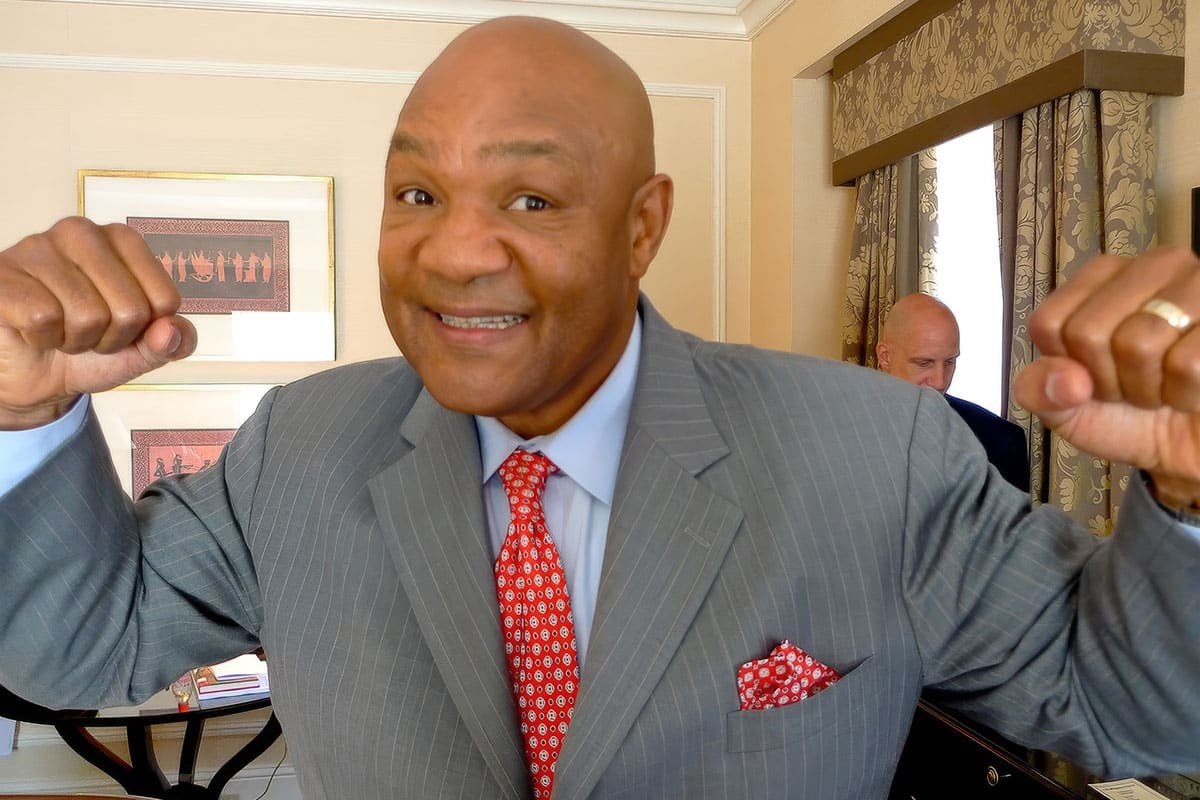
In 1996, George Foreman appeared on QVC to demonstrate a countertop grill that had been struggling to find its audience.
The segment was going fine. Not spectacular, but fine. Foreman was doing what he had been doing since 1994, showing up with his infectious grin, cooking meat on both sides simultaneously, explaining how the slanted surface drained the fat away. The pitch was solid. The product was genuinely useful. But something was missing the spark that turns a capable demonstration into a purchasing frenzy.
Then, during a rare idle moment in the 30-minute segment, Foreman did something that was not in the script. He reached over, grabbed a burger hot off the grill, and ate it. Right there on live television. Not as a performance, just as a man who was genuinely hungry and genuinely enjoyed what he had just cooked.
The QVC phone lines immediately overwhelmed. Workers on the studio floor described it as “going red,” or the moment when call volume exceeds capacity and everyone in the building, janitors and accountants included, drops what they are doing and picks up a phone to take sales calls. In the three minutes following that single unscripted bite, Salton sold approximately 40,000 grills.
No advertisement planned for months could have produced that result. No focus-grouped tagline, no celebrity appearance fee, no polished campaign. Just the right person, being genuinely themselves, at exactly the right moment.
The story of how that moment came to exist, and how it almost featured a completely different person, is considered one of the greatest marketing case studies ever told.
A Grill Nobody Wanted (Yet)
The product itself started life with a name that tells you everything about why it was struggling. Michael Boehm, an inventor from Batavia, Illinois, had designed an ingenious countertop appliance: a dual-sided grill set on a slant, so food cooked on both sides simultaneously while the fat drained away from the meat into a separate tray below. It was genuinely clever engineering. It made healthier cooking faster and easier than anything available at a similar price point. Boehm had filed his patent and spent the early 1990s taking it to trade shows under the name “The Fajita Express.”
The Fajita Express generated almost no interest. The problem was not the product. The problem was that nobody could picture themselves using it. A fajita grill was a solution to a problem most people did not know they had, sold under a name that narrowed its appeal before anyone got close enough to understand what it actually did. Boehm had a great invention and a positioning problem.
Eventually, the product found its way to Salton, Inc., a small Illinois kitchen appliance company that recognized the potential and agreed to manufacture it. What Salton needed was a celebrity endorser who could give the grill an identity, someone whose name and face would answer the question “why would I want this?” before a customer ever read a word of marketing copy.
But depending who you ask, their first choice was not George Foreman.
The Meatball Maker That Changed History
By almost any measure, Hulk Hogan in 1994 was a more bankable celebrity than George Foreman. His face was one of the most recognized on earth. Wrestling’s crossover into mainstream entertainment had made him a genuine pop culture icon. He had appeared in movies, on talk shows, and in commercials for major brands. If you were a small appliance company in Illinois looking for a name to put on a kitchen product, Hulk Hogan was a reasonable first call.
As the story goes, Hogan’s agent, who also represented George Foreman, came to his client with a choice of three products to endorse: a blender, a meatball maker, and the countertop grill that Salton was trying to launch. By Hogan’s own later admission, he chose the meatball maker. His reasons have shifted across various interviews over the years. In one telling, he missed the phone call from his agent and the grill went to another client by default. In another, he simply picked the wrong product from the three options in front of him.
The Hulk Hogan Meatball Maker was produced and sold. It disappeared without leaving a trace on the culture or Hogan’s bank account. He later attempted to recover with the Thunder Mixer, the Hulkster Burger line at Walmart, and eventually his own grill, the Hulk Hogan Ultimate Grill, which was recalled in 2008 due to a fire hazard. None of them came close to the original product he had passed on.
The grill went down the list. Salton sent a prototype to George Foreman’s team. For months, Foreman ignored it.
Why George Foreman Was the Only Person Who Could Have Done This
To understand why the George Foreman Grill became what it became, you have to understand what George Foreman was in 1994, because it was one of the most extraordinary personal transformations in the history of American public life.
The George Foreman of the early 1970s was feared. He was the most physically intimidating heavyweight of his era. A scowling, silent destroyer who held the world heavyweight title and defended it with a ferocity that made even experienced boxing observers uncomfortable. His loss to Muhammad Ali in the “Rumble in the Jungle” in 1974 was followed by a decade of decline and eventual retirement in 1977. He had earned significant money from boxing and spent most of it. By the mid-1980s, he was nearly broke, running a youth center in Houston on whatever donations came in.
What happened next is the foundation of everything that followed. Foreman underwent a profound religious conversion, became an ordained minister, and rebuilt his public persona from the ground up. The man who returned to boxing in 1987 was not the same person who had left. He was warm, funny, self-deprecating, and genuinely approachable. A bear of a man who made jokes about his own appetite, laughed easily, and seemed to radiate a kind of uncomplicated joy that his earlier incarnation had never possessed.
In November 1994, the same year Salton was trying to find a spokesperson for its grill, Foreman did something nobody believed was possible. At 45 years old, he knocked out 26-year-old Michael Moorer to reclaim the world heavyweight championship. He became the oldest heavyweight champion in history. The punch was so powerful, it broke Moorer’s mouthguard in half. America fell in love with him all over again. Not as the intimidating destroyer he had once been, but as the improbable, joyful comeback king who had beaten the odds and then grinned about it.
When Salton’s team eventually reached Foreman through his lawyer and friend Sam Perlmutter, the conversation that followed was almost comically on-brand. Foreman’s manager proposed not a standard endorsement deal but a joint venture. Foreman would receive 40 percent of the profits from every grill sold in exchange for promoting it aggressively. Salton agreed. Foreman’s reaction to the terms of the deal, as he later recounted it, was genuine puzzlement. His manager was asking him to promote a product for no upfront fee. Foreman remembered asking what he would be paid.
“Nothing, George,” came the reply. “But there’s a thing now called a joint venture.”
Foreman signed. And once he started using the grill at home, something clicked. He genuinely liked it. A man who cared deeply about food, who had restructured his eating habits as part of his comeback, who had spent years thinking about how to cook meat in a way that was both satisfying and healthier. Here was a product that actually solved a problem he actually had. That genuine enthusiasm was not manufactured. It could not be manufactured. And it was the thing that made everything that followed possible.
The Infomercial, the Burger, and the Moment Everything Changed
The early infomercial for the George Foreman Lean Mean Fat-Reducing Grilling Machine was not an immediate sensation. The first version leaned too heavily on boxing footage. Foreman in the ring, Foreman training, Foreman as champion. Salton’s CEO Leon Dreimann recognized the problem and ordered a retool. Out went the pugilism. In came Foreman as a neighbor, grilling on the counter, surrounded by his children (he had 12 kids, and named five of his sons George), laughing, talking about food with the easy familiarity of someone who actually cooked every day.
The infomercials ran constantly. Late night. Early morning. The kind of television real estate that advertising professionals considered second-tier. But Foreman’s presence turned two-in-the-morning product demonstrations into something genuinely watchable. He was not performing. He was just being George Foreman. And George Foreman, it turned out, was enormously compelling at two in the morning or any other time.
The New York Times ran a favorable review of the grill on December 31, 1997, landing just as millions of Americans were making New Year’s resolutions about eating better. The timing was accidental and perfect. Sales accelerated.
And then came the QVC appearance, and the burger, and the moment that cannot be scripted or replicated by any marketing team on earth. Foreman, in a brief pause during the demonstration, simply reached over and ate the food he had just cooked. The phones exploded. 40 thousand grills sold in three minutes. QVC employees have described it as one of the most extraordinary sales events they had ever witnessed, triggered entirely by one man’s genuine appetite.
At its peak, Foreman was earning $8 million a month from grill royalties. In 1999, Salton paid him $138 million in a lump sum to buy the perpetual rights to use his name on the product. By the time the grill had been on the market for 15 years, it had sold over 100 million units worldwide. George Foreman, the man who had nearly gone bankrupt after blowing through his boxing fortune, had earned more from a countertop appliance than from his entire career in the ring.
Where the George Foreman Grill Stands Today
The George Foreman Grill still exists and still sells. Following Salton’s acquisition by Spectrum Brands in 2010, the product line has continued under the Spectrum umbrella with updated models, expanded sizes, and new features, though the core concept of the dual-sided, fat-draining countertop grill remains unchanged from Michael Boehm’s original design.
George Foreman passed away in March 2025 at the age of 76. His legacy in boxing, which included two heavyweight championships spanning three decades, the famous “Rumble in the Jungle” against Muhammad Ali, the oldest heavyweight champion in history, is secure. But for a generation of Americans who grew up watching late-night infomercials and keeping a countertop grill in their college apartment, his name will always be as closely associated with a kitchen appliance as with a boxing ring. He earned more from that association than from every fight he ever won.
The grill itself has become a cultural artifact, referenced in The Office, celebrated in food culture retrospectives, still present on the countertops of millions of households decades after its peak cultural moment. It is the rare product that outlasted the era that made it famous because it was actually, genuinely useful. The marketing got people to buy it. The product made them keep it.
What the George Foreman Grill Teaches Every Business About Endorsement and Authenticity
The marketing genius of the George Foreman Grill is not that Salton found a famous person and put their name on a product. That is the most common and most often unsuccessful strategy in the history of celebrity endorsement. The genius is that they found the right person, and the right person was not the most famous one available.
Hulk Hogan in 1994 was better known globally than George Foreman. He had more mainstream celebrity, more recent cultural visibility, a larger recognizable name. He could not have sold a fat-reducing grill to save his life, because nobody could picture Hulk Hogan caring about fat reduction. The meatball maker was actually a more logical fit, which is why his agent offered it to him. The meatball maker failed anyway.
George Foreman worked because every element of his personal story confirmed the product’s promise. He was a man who had genuinely rebuilt his health and his life through better habits, including better eating. He was a man visibly associated with food, the two pre-fight hamburgers were part of his public legend. He had the warmth and accessibility of someone you would actually want cooking in your kitchen. And he had a comeback narrative that made every success he had feel earned rather than inevitable, which made the audience root for him in a way they never would have rooted for someone younger, smoother, and less visibly human.
The QVC burger moment is the purest expression of this. It was not marketing. It was a man being himself, and that authenticity (real, unscripted, unoptimized) converted more customers in three minutes than any carefully crafted campaign could have done in three months. The lesson is not that you should eat on live television. The lesson is that genuine belief in what you are selling is more powerful than any pitch, and that the right messenger is the one whose credibility makes the product’s claim feel obvious rather than argued.
The joint venture structure deserves its own mention. Foreman’s manager did not negotiate a flat fee, the standard arrangement that would have paid Foreman a fixed amount regardless of how well the grill performed. He negotiated a percentage of every unit sold. That structure aligned Foreman’s incentives perfectly with the product’s success. The more he promoted it, the more he earned, which meant he promoted it everywhere, all the time, with the energy of someone whose financial future depended on making believers out of every person he talked to. It was not an endorsement. It was a partnership. And the difference between those two things is the difference between a spokesperson who shows up when required and one who genuinely cannot stop selling.
For any business thinking about partnerships, influencer relationships, or brand ambassadors, the Foreman model is the one that works. Find someone who genuinely uses and believes in what you offer. Structure the relationship so their success is tied to yours. Then get out of the way and let authenticity do what no advertising budget ever could.
Key Takeaways
- The right spokesperson is not the most famous one. It is the most credible one. Hulk Hogan was more globally recognized than George Foreman in 1994. He could not have sold a fat-reducing grill because nothing about his personal story confirmed the product’s promise. Foreman could, because everything about him did.
- Genuine belief converts. Performance does not. Foreman did not sell the grill like a spokesman. He talked about it like a man who genuinely used it and liked it. That authenticity, most visibly expressed in the unscripted QVC burger moment, generated results that no scripted campaign could have produced.
- Structure incentives so your partner’s success is your success. The joint venture arrangement that gave Foreman 40 percent of profits made him one of the most motivated salespeople in American consumer product history. A flat fee buys presence. A shared stake buys genuine effort.
- The product has to be genuinely good. Foreman’s authenticity would have evaporated instantly if the grill did not actually work. The marketing got people to buy it. The product made them keep it, tell their friends about it, and buy another one when the first wore out. Over 100 million units sold is not a marketing achievement, it is a product achievement that marketing made possible.
- Timing and context are as important as the message. Foreman’s comeback story, his reputation for eating well, the 1990s health and fitness wave, and the rise of the infomercial as a sales channel all converged at the same moment. The right person with the right product needs the right moment, and recognizing that moment when it arrives is its own kind of marketing genius.
FAQs About the George Foreman Grill
Did Hulk Hogan really turn down the George Foreman Grill?
The story is real, though the specific details have shifted across various accounts Hogan has given over the years. The consistent thread across all versions is that Hogan was offered the opportunity to endorse the grill (or a grill) through his agent, and chose a different product instead, with the meatball maker most frequently cited as his actual selection. Whether the exact product he passed on was precisely the grill that became the George Foreman Grill or a similar product remains slightly unclear, but the broader truth is not. Hogan chose the wrong product, the grill went to George Foreman, and the financial difference between those two decisions is estimated at over $200 million.
How much did George Foreman make from the grill?
By Foreman’s own account, substantially more than $200 million. He described months in which he was receiving $8 million in royalty payments. In 1999, Salton paid him $138 million in a lump sum to purchase the perpetual rights to use his name on the product. Before that buyout, he had been receiving approximately 40 percent of the profits from every unit sold. The total is estimated to exceed $250 million, significantly more than he earned across his entire boxing career, which itself included some of the sport’s most lucrative fights.
What marketing lessons can small businesses take from the George Foreman Grill story?
Three lessons translate directly to any scale of business. First, when seeking partners, ambassadors, or spokespeople (whether that means an influencer, a local community figure, or a satisfied customer willing to share their experience), prioritize credibility over reach. The person whose story naturally confirms your product’s promise will always outperform the person who is simply well known. Second, structure relationships so that your partners benefit directly from your success. Shared stakes produce genuine effort in a way that flat fees never do. Third, and perhaps most importantly: no amount of marketing can substitute for a product that genuinely works. The George Foreman Grill sold over 100 million units because it actually made food taste better with less fat and less effort. That is the foundation on which everything else was built.
At Resolution Promotions, we believe the most powerful marketing is built on the same foundation that made the George Foreman Grill a phenomenon: the right message, delivered by the right voice, to the right audience, at exactly the right moment. If you are ready to build that kind of marketing for your business, let’s talk.