

A Retail Experience That Defined a Generation
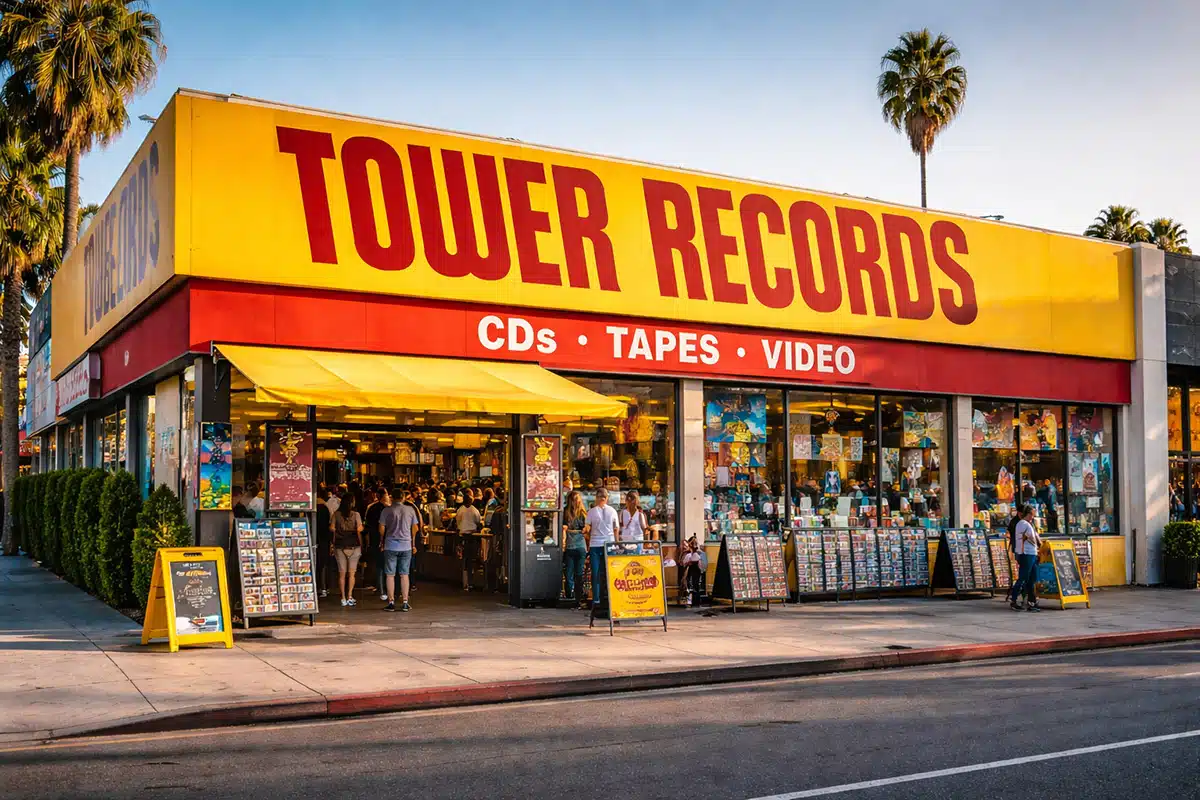
Long before streaming services made nearly every song recorded instantly accessible, buying music required time and intention. It was something people planned for. A trip to the record store was not simply an errand squeezed between other stops, it was often the destination itself. For many, that destination was Tower Records, a store whose bright yellow-and-red signage became as recognizable as any brand in retail during the late twentieth century.
Walking into a Tower location felt less like entering a store and more like stepping into a cultural gathering place. Customers lingered. They flipped through vinyl sleeves, scanned endless walls of CDs, and debated recommendations with employees who often felt more like music journalists than sales associates. New releases created real anticipation, and midnight launches attracted lines that wrapped around city blocks. The environment encouraged discovery in a way that felt organic and personal, something that algorithms would later try (and struggle) to replicate.
At its height, Tower Records was not merely selling albums. It had positioned itself at the center of music culture, shaping how people explored and experienced sound. Few retailers ever achieve that kind of emotional connection with their customers, and even fewer manage to sustain it for decades. Which is precisely why its disappearance still feels surprising.
Humble Beginnings and an Unlikely Empire
Tower’s rise did not begin with corporate ambition or venture capital. In 1960, founder Russ Solomon started selling records out of a small section of his father’s drugstore in Sacramento, California. His early strategy was straightforward: offer more selection than anyone else and treat music fans like serious consumers rather than casual shoppers. While other stores focused on popular titles and predictable inventory, Solomon stocked everything he could find, from obscure imports to niche genres that most retailers ignored.
That commitment to depth quickly earned Tower a reputation as the place where you could find what no one else carried. Word spread, and the small operation expanded into standalone stores. Those stores grew larger, stayed open later, and stocked even more titles. The company scaled without losing the personality that made it special. Employees were hired for their knowledge and passion, not just their ability to ring up a sale.
By the 1980s and 1990s, Tower Records had grown into an international brand with hundreds of locations and billions in annual revenue. Flagship stores in cities like Los Angeles and New York became landmarks in their own right. For many customers, browsing Tower was as much a part of city life as visiting a favorite café or bookstore. It was retail with character, and that character created loyalty that most competitors could only envy.
From the outside, it appeared that Tower Records had built something permanent.
Success That Masked a Slow Shift
Like many companies that dominate their category for years, Tower Records became exceptionally good at operating within the system it understood. Large stores, deep inventory, and steady foot traffic formed the backbone of the business model. That approach had worked reliably for decades, which made it easy to assume it would continue working indefinitely.
Meanwhile, subtle changes were unfolding outside those walls. College students began trading MP3 files. CD burners made it possible to copy entire albums at home. File-sharing services such as Napster introduced the idea that music could be obtained digitally and instantly. What initially appeared to be fringe behavior gradually became mainstream habit.
The music industry itself responded quickly. Apple Inc. introduced iTunes and normalized the purchase of individual digital tracks rather than full albums. Shortly thereafter, streaming services such as Spotify shifted the model even further, emphasizing access over ownership. Consumers no longer needed shelves, cases, or physical media at all. Entire collections could live on a laptop or phone.
The fundamental value proposition of a record store (selection and availability) had suddenly been replicated, and then surpassed, by software.
For Tower Records, whose identity was built around the physical browsing experience, that shift posed a deeper challenge than it first appeared. The company continued investing heavily in expansive real estate and inventory while treating digital initiatives as secondary. By the time leadership fully acknowledged how dramatically behavior had changed, the convenience of downloads and streaming had already reset customer expectations.
And once convenience becomes the norm, it is nearly impossible to convince customers to go backward.
The Gradual Disappearance of an Icon
Unlike some corporate collapses that happen suddenly, Tower’s decline unfolded quietly. Sales softened year after year as fewer customers felt the need to visit a physical store. The large footprints that once signaled dominance became liabilities, saddling the company with high overhead at the exact moment revenue was shrinking. Debt accumulated. Margins tightened.
In 2004, the company filed for bankruptcy protection. Efforts to restructure bought time but did not reverse the broader trend. Two years later, another bankruptcy filing sealed its fate. Stores that had once bustled with activity were reduced to liquidation events, their shelves stripped bare and their posters replaced by discount signs. By the end of 2006, most U.S. locations had closed permanently.
The irony was difficult to ignore. Interest in music had not declined at all. If anything, people were listening more than ever. The demand had not disappeared. The format had simply changed, and Tower had been too slow to change with it.
Today, Tower Records exists in a far smaller and quieter form. The U.S. retail empire that once spanned hundreds of locations has largely been reduced to an online storefront that sells vinyl, merchandise, and nostalgia to longtime fans, while Tower Records Japan (which operated independently from the American parent) continues to run a successful network of physical stores across Japan where demand for CDs and collectibles has remained strong. In many ways, Tower has shifted from being a dominant global retailer to a legacy brand, remembered as much for the experience it created as for the products it sold, a reminder that even beloved institutions must continually reinvent themselves to stay relevant.
The Lesson That Extends Beyond Music
Tower Records did not fail because customers stopped caring about the brand. Many still speak about it fondly today. Nor did it fail because it lacked recognition or goodwill. It had both in abundance. Instead, it struggled because it optimized for the past while the market moved toward the future.
That pattern is not unique to music retail. It shows up repeatedly across industries. Businesses become experts at the systems that made them successful and, in doing so, sometimes overlook early signals that those systems are becoming outdated. By the time the shift feels urgent, competitors who adapted earlier have already captured the advantage.
The lesson is less about nostalgia and more about awareness. Markets evolve continuously. Consumer behavior changes quietly at first and then all at once. Companies that survive tend to be the ones willing to rethink their model before they are forced to.
Staying Relevant by Design, Not by Accident
For modern businesses (especially local and regional brands), the Tower Records story serves as a reminder that visibility and relevance require deliberate effort. Today’s equivalents are not CD walls or storefront size. They are digital presence, search visibility, content strategy, and emerging technologies like AI-driven discovery. Ignoring those shifts can feel harmless in the short term, but over time the gap becomes difficult to close.
At Resolution Promotions, we view that reality as an opportunity rather than a threat. The goal is not simply to help businesses look established. It is to help them remain discoverable and adaptable as the landscape changes. Strong websites, thoughtful content, search optimization, and forward-looking strategy ensure that brands meet customers where they are going, not where they used to be.
Because the risk for any business is not competition. It is becoming a fond memory people talk about years later.
FAQs About Tower Records
Why did Tower Records go out of business?
High operating costs, heavy debt, and a slow transition to digital music left Tower Records unable to compete with downloads and streaming platforms.
When did Tower Records close?
Most U.S. locations shut down after bankruptcy proceedings in 2006.
What can businesses learn from Tower Records?
Adapt early to changing technology and consumer behavior, and invest consistently in digital visibility and strategy.