If you are of a certain age, the orange roof still does something to you.
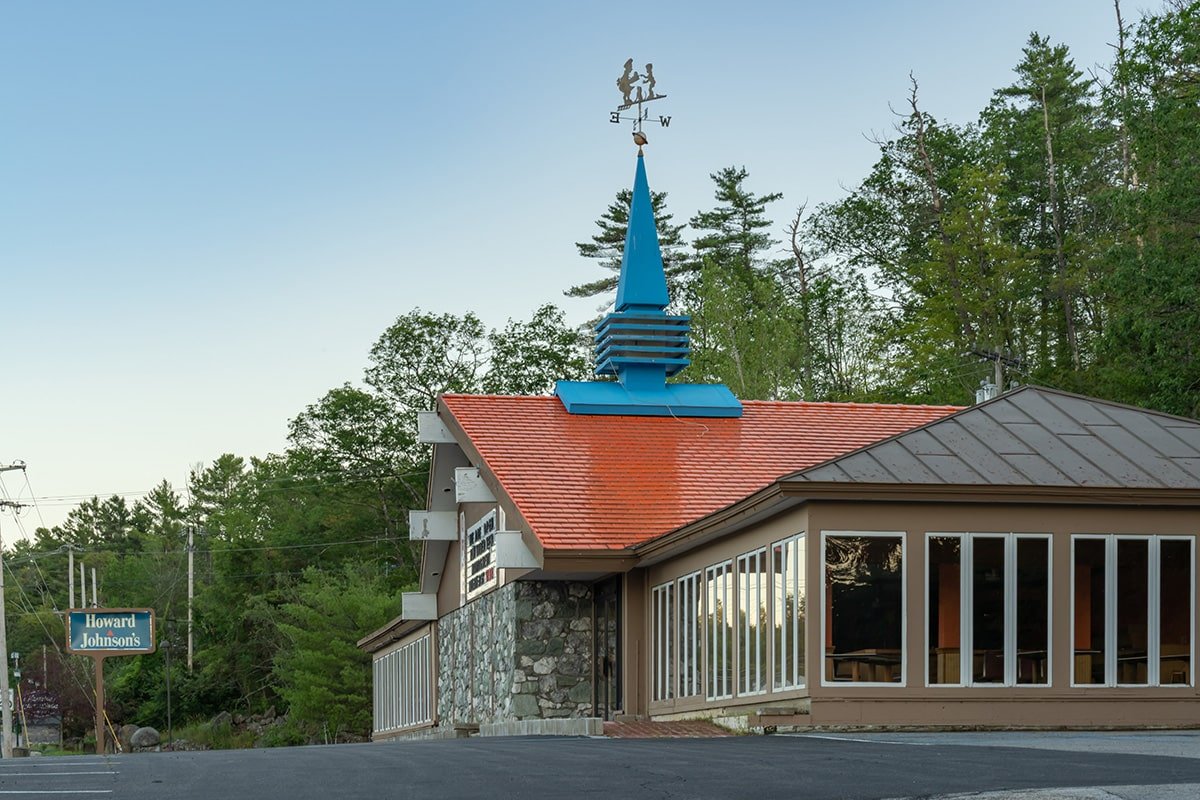
Not just a memory, a feeling. The backseat of the family station wagon on a long summer drive, the anticipation building as that unmistakable tangerine silhouette appeared over the highway horizon. The blue cupola. The Simple Simon weathervane spinning in the breeze above. The knowledge, certain as gravity, that fried clams and 28 flavors of ice cream were minutes away. For an entire generation of American kids, Howard Johnson’s was not just a restaurant. It was a destination. A reward. A place that made the long miles worth it.
At its peak in the 1960s and 1970s, Howard Johnson’s had more than 1,000 locations across the United States. That was more than McDonald’s, Burger King, and Kentucky Fried Chicken combined. It was the largest restaurant chain in America. It had invented the modern concept of highway dining. It had pioneered franchising before franchising had a name. It had employed a classically trained French chef to design its menus. It had turned a soda fountain in Quincy, Massachusetts, into one of the most recognized brands in the country, with an orange roof as visible and as trusted as any landmark on the American roadside.
The last Howard Johnson’s restaurant (a single location in Lake George, New York) closed its doors in 2022. 100 years after Howard Deering Johnson started selling ice cream to make ends meet, the empire he built had been reduced to nothing.
The story of how it got there is worth telling carefully. Because Howard Johnson’s did not fail because it was bad. It failed because it stopped being good at exactly the wrong moment. And because a generation of owners after the founder never quite understood what they had actually bought.
A Drugstore, a Debt, and 28 Flavors
Howard Deering Johnson was not born into the restaurant business. He was born in Boston in 1897, dropped out of school to sell cigars for his father, and by the early 1920s found himself inheriting a failing drugstore in Quincy, Massachusetts, along with $28,000 in debt he did not ask for. The store had a soda fountain. Johnson decided to make the most of it.
He started experimenting with ice cream, reportedly acquiring a recipe from a local German pushcart vendor and then obsessively refining it, nearly doubling the butterfat content of standard recipes until the result was smoother, richer, and genuinely different from what anyone else was selling. He started with three flavors: vanilla, chocolate, and strawberry. Then curiosity took over. By the time he was done experimenting, he had 28 flavors. Butter pecan. Caramel fudge. Coffee. Fudge ripple. Peanut brittle. Butterscotch. The list read like the menu of a very ambitious ice cream dream.
He peddled the ice cream from beach stands along the Massachusetts coast during summers, and the response was immediate. People came back. They told their friends. In 1929, with a loan from Granite Trust Bank, Johnson opened his first proper restaurant in Quincy. He served traditional New England comfort food alongside the ice cream (roast turkey, fried clams, chicken pot pie, baked beans, hot dogs in a split-top bun that he essentially invented), and the restaurant was, from almost the first day, packed.
An early and improbable stroke of luck accelerated everything. In 1929, Boston’s mayor banned a production of Eugene O’Neill’s play Strange Interlude from being performed in the city. The theater company moved the production to nearby Quincy, and the curious crowds who came to see the controversial play discovered Howard Johnson’s restaurant right next door. Night after night, the dining room filled with Boston’s cultural elite. The restaurant’s reputation spread across social circles that Johnson never could have reached through ordinary advertising. Within months, Howard Johnson’s was the most talked-about dining room in the region.
Johnson recognized what he had and began thinking about how to replicate it. In 1935, he made a decision that would change the American restaurant industry forever. Rather than borrowing money to open a second location himself, he invited a friend named Reginald Sprague to open a Howard Johnson’s on Cape Cod (using Johnson’s name, his recipes, his standards, and his orange roof) in exchange for a percentage of the revenue. It was, for all practical purposes, the first modern restaurant franchise agreement in American history. Johnson had invented the model that McDonald’s, Burger King, and every fast food chain that followed would eventually use to conquer the world.
The Orange Roof That Became Its Own Billboard
Howard Johnson understood something about the American highway that his competitors missed entirely: the road itself was the marketing.
In an era when roadside billboards were proliferating across the country (often ugly, usually cluttered), Johnson took a different approach. He made the building the billboard. The design he settled on was a white colonial structure with a bright orange tile roof, a blue cupola, and a steeple topped by the Simple Simon and the Pieman weathervane. Floodlights illuminated the roof at night. The whole structure was engineered to be visible from a distance, recognizable in an instant, and reassuring by design. It looked like a church or a town hall, something solid and trustworthy that belonged to the American landscape.
He also selected his locations with unusual precision, targeting spots where highways curved or where traffic naturally slowed, where a driver’s eyes would be scanning the horizon and would inevitably land on that orange roof. He did not need billboards. The building itself was visible for half a mile and told you everything you needed to know before you ever read a sign.
Inside, the experience was equally deliberate. Every Howard Johnson’s looked the same. Knotty pine walls, the same menu, the same portions, the same Simple Simon logo on the placemats and the coffee cups and the ice cream dishes. Johnson was obsessive about consistency in a way that predated Ray Kroc’s famous fastidiousness about McDonald’s by decades. A family stopping at a Howard Johnson’s in Connecticut knew exactly what they would find at a Howard Johnson’s in Florida. That predictability was not a limitation. It was the entire value proposition. In a country of strangers navigating unfamiliar roads, Howard Johnson’s was the known quantity, the familiar face, the place where you already knew what to order.
He also hired a French-trained chef named Jacques Pépin, who would later become one of the most celebrated culinary figures in America, as his director of research and development. Pépin spent years at Howard Johnson’s developing and standardizing recipes, working to ensure that every fried clam and every macaroni and cheese in every location met the same standard. The food was not fine dining. It was not trying to be. But it was genuinely good, honestly priced, and made with real care. And in the middle of the American century, when a young country was discovering the freedom of the open road, that was exactly what people wanted.
By 1940, there were more than 130 Howard Johnson’s restaurants spanning the East Coast, but World War II nearly ended everything. Gas rationing decimated highway traffic, and by 1944 only 12 locations remained open. Johnson kept the company alive by landing military contracts to feed troops, a survival move that also gave him the operational discipline to scale rapidly when the war ended and Americans took to the roads again with a pent-up ferocity that the country had never seen. By the late 1950s, Howard Johnson’s was the biggest restaurant chain in America. In the 1960s, it was also building motor lodges alongside the restaurants, offering travelers a complete package (dinner, bed, breakfast) under one familiar orange roof.
It was an empire. And like most empires, the seeds of its decline were planted at the very height of its power.
The Son Who Inherited Everything Except the Instinct
In 1959, Howard Deering Johnson handed the company to his son, Howard Brennan Johnson, who was known within the company as Bud. The elder Johnson was a founder in the fullest sense. A man who had built something from nothing and understood, at a cellular level, why every detail mattered. The ice cream recipe, the roof color, the consistent menu, the quality standards. These were not corporate policies to him. They were the company. They were what the orange roof meant.
Bud Johnson ran the company competently through the 1960s and into the early 1970s. The chain hit 1,000 locations. The motor lodge business expanded to more than 500 properties. The brand was at its peak reach and its peak recognition. But underneath the growth, something was shifting that Bud did not fully reckon with.
The American highway was changing. The Interstate Highway System, which had begun under Eisenhower in the late 1950s, had fundamentally altered travel patterns by the early 1970s. Howard Johnson’s restaurants had been strategically sited along the old two-lane routes, the places where travelers slowed down, where the curves of the road delivered customers to the parking lot. The interstates bypassed many of those locations entirely, routing traffic past towns and exits that had been HoJo’s bread and butter for a generation.
Then the oil crisis of 1973 hit. Gas shortages kept people home. The recession that followed stripped away the disposable income that had fueled a decade of family road trips. Simultaneously, and this was the competitive blow that would ultimately prove fatal. A new generation of fast food chains was roaring into the highway landscape with something Howard Johnson’s could not easily match in speed, low prices, and drive-through windows. McDonald’s under Ray Kroc was every bit as obsessive about standardization and quality control as the elder Johnson had been. But its menus were smaller, its real estate requirements were modest, and a family of four could eat for half the price of a Howard Johnson’s sit-down meal.
Bud Johnson’s response to all of this was to begin relaxing the standards his father had maintained with such discipline. The quality of the food began to slip. Franchisees, feeling the financial pressure, cut corners that the company had once enforced without compromise. The consistency that had been Howard Johnson’s greatest competitive asset (the very thing that made the orange roof a promise rather than just a sign) started to erode. A traveler who had been stopping at Howard Johnson’s for 20 years began to have bad experiences for the first time. And for a business built entirely on trust, a bad experience is not a setback. It is a reason not to come back.
In 1979, Bud Johnson sold the company to Britain’s Imperial Group (formerly the Imperial Tobacco Company) for $630 million. It was a remarkable sum for a business in visible decline. The British buyers perhaps did not fully appreciate how much of Howard Johnson’s value lived not in its assets but in the discipline that had created them, and how much of that discipline had already quietly left the building.
Passed From Hand to Hand Until There Was Nothing Left to Pass
What followed the 1979 sale is a story that repeats itself with depressing regularity in the history of beloved American brands: a succession of owners who understood the financial value of what they had acquired without understanding the cultural value that created it, each one attempting to revive a brand by investing in everything except the thing that actually made it worth reviving.
Imperial Group tried to update the restaurants and the motels. The efforts had little success and significant cost. In 1985, just six years after paying $630 million, Imperial sold Howard Johnson’s to Marriott for $314 million. The company had lost half its value in less than a decade. Marriott promptly sold hundreds of locations, separating the hotel and motel business from the restaurant business in a move that severed the integrated travel experience that had been central to Howard Johnson’s identity. The franchisee owners formed their own association and purchased trademark rights, but without centralized quality control or a unifying vision, the remaining restaurants continued to drift.
By the 1990s, there were fewer than 100 Howard Johnson’s restaurants remaining in the United States. The orange roofs that had once crowned a thousand highway exits were being painted over, sold, or simply torn down. The Simple Simon weathervane that had spun above a generation’s most vivid food memories was disappearing from the American landscape one exit ramp at a time.
The motel business survived, eventually passing to Wyndham, which still operates Howard Johnson hotels in a handful of locations today. But the restaurants (the fried clams, the 28 flavors, the knotty pine dining rooms where America ate its road trip meals) are gone. The last restaurant, in Lake George, New York, where a teenage Rachael Ray once worked as a waitress, closed in 2022. 100 years after Howard Deering Johnson started experimenting with ice cream to pay off his father’s debts, it was over.
What Howard Johnson’s Knew That Its Successors Forgot
The temptation, looking back at Howard Johnson’s, is to blame the external forces: the interstate highways that rerouted traffic, the oil crisis that kept families home, the fast food chains that undercut the prices. Those things all happened, and they all mattered. But they do not fully explain the collapse of a brand that was, by any measure, better positioned than its competitors when those challenges arrived.
McDonald’s faced the same oil crisis. The same interstates. The same competitive environment. And still, McDonald’s is currently the largest fast food chain on earth. The difference was not the external conditions. It was what each company did with them.
Howard Deering Johnson built his company on a very specific proposition. Wherever you are, whatever road you are on, the orange roof means you know what you are getting. The ice cream will be rich. The clams will be crispy. The dining room will look exactly like the one three states back. That consistency was the product. It was not a feature of the product. It was the thing itself, the reason a family in an unfamiliar state chose HoJo’s over the unknown diner across the road.
When Bud Johnson began relaxing the standards that maintained that consistency, he was not simply cutting costs. He was dismantling the reason people had trusted the brand in the first place. And when the company passed to owners who had no institutional memory of why those standards had existed, the dismantling accelerated. The orange roof that had once been a promise became, over time, merely a paint color.
There is also a lesson here about what gets lost in a sale. Bud Johnson sold a brand, a set of locations, a trademark, and a financial history. He could not sell the instinct his father had carried. The understanding that every detail mattered, that the quality of the ice cream and the cleanliness of the dining room and the correctness of the portion size were not operational concerns but brand promises. That kind of knowledge is not transferable through an acquisition document. It lives in the people who built the thing. And when they leave, it often leaves with them.
The AND1 basketball brand learned a version of the same lesson. So did Starter Jackets. So did dozens of other brands whose stories we have told here. The pattern is remarkably consistent. A founder builds something great by caring deeply about every detail. Someone else acquires it because the financial metrics look compelling. The details that made the metrics possible gradually receive less care. The metrics follow the details downward. The story ends.
Howard Johnson’s is a ghost now. But if you look carefully, you can still find the orange rooftops in old photographs and faded postcards. A color so specific, so perfectly calibrated to be impossible to miss on a sunlit highway, that it is almost impossible to look at without feeling something. That is what great branding does. Even after the restaurants are gone, the feeling persists. The orange roof outlasted the orange roof.
That is the final lesson of Howard Johnson’s, and maybe the most important one. The founder built something so distinctively itself, so anchored in a specific promise and a specific feeling, that 100 years later, people who have never eaten a fried clam in their lives recognize the color and feel a pull of nostalgia for something they never even had. Building that kind of brand identity (that deep, that specific, that emotionally resonant) is extraordinarily difficult. And it is, in the end, the only thing that truly lasts.
Key Takeaways
- Consistency was the product, not a feature of it. Howard Johnson’s value proposition was not the food itself. It was the guarantee that the food would be the same everywhere, every time. When that guarantee eroded, the brand lost the reason customers had trusted it. Consistency is not an operational detail. It is the promise your brand makes.
- The founder’s instinct is not transferable by acquisition. Howard Deering Johnson’s obsessive attention to quality and detail was the engine of everything the brand achieved. That obsession could not be written into a purchase agreement. When the people who understood why every detail mattered left the company, the details began to matter less. And the brand followed.
- Visibility is a strategy, not an accident. The orange roof was not just a design choice. It was a deliberate system, engineered to be seen from a distance, to communicate trust at a glance, to make the building its own billboard. Howard Johnson understood that being found was as important as being good.
- Complacency at the peak is the most dangerous moment. Howard Johnson’s began relaxing its standards at the exact moment when external competitive pressures were intensifying. McDonald’s faced identical conditions and doubled down on operational discipline. The outcome of each approach speaks for itself.
- The most durable brands are built on a specific feeling, not just a product. Years after the last Howard Johnson’s closed, people who never ate there feel something when they see the orange roof in an old photograph. That emotional residue (built through decades of consistent, caring execution) is the rarest and most valuable thing a brand can produce.
FAQs About Howard Johnson’s
What happened to Howard Johnson’s restaurants?
Howard Johnson’s declined through a combination of internal and external forces across the 1970s and 1980s. Changing highway patterns, the oil crisis, and the rise of fast food chains created significant competitive pressure. Simultaneously, the company began relaxing the quality and consistency standards that had built its reputation. After founder Howard Deering Johnson’s son sold the company in 1979, the brand passed through several ownership changes (from Imperial Group to Marriott to franchise associations), with each transition eroding the operational discipline that had made the brand great. The last Howard Johnson’s restaurant closed in Lake George, New York, in 2022. The hotel brand still exists under Wyndham.
Why did Howard Johnson’s invent franchising?
Howard Johnson did not set out to invent franchising. He stumbled into it out of necessity. When he wanted to open a second location in 1935 but lacked the capital to do it himself, he arranged for a friend to open and operate a Howard Johnson’s using his recipes, standards, and brand identity in exchange for a percentage of revenue. That arrangement, essentially the first modern restaurant franchise agreement, proved so effective at scaling the brand that Johnson continued using it as his primary growth strategy. By the time McDonald’s and other chains popularized franchising in the 1950s and 1960s, Howard Johnson’s had already been operating the model for two decades.
What were Howard Johnson’s 28 flavors of ice cream?
The exact lineup varied slightly over the decades, but the 28 flavors that made Howard Johnson’s famous included classics like vanilla, chocolate, and strawberry alongside more distinctive offerings like butter pecan, caramel fudge, fudge ripple, peanut brittle, coffee, butterscotch, coconut, macaroon, banana, peach, and others. Johnson developed them over years of experimentation using a high-butterfat base recipe that made his ice cream noticeably richer and smoother than what his competitors served. The number 28 itself became a marketing device. Howard Johnson’s even ran a promotion where customers who could prove they had sampled all 28 flavors received their next cone free. The least popular flavors were periodically retired and replaced, but the total never exceeded 28.
At Resolution Promotions, we believe the most durable brands are built the way Howard Johnson built his. With obsessive attention to consistency, a clear and distinctive identity, and a genuine promise kept every single time. If you are ready to build something that lasts, let’s talk.