Picture this. Sometime in the mid-1990s, your family is on vacation. Maybe it is in Orlando. Maybe it is in New York City or Las Vegas. Maybe it is a big shopping mall somewhere in the middle of the country that has turned a Tuesday into a destination.
The line outside is long. The neon is bright. Through the doors you can hear the music. Rock and roll, maybe, or the ambient sounds of a tropical rainforest. Inside, the walls are covered with things you recognize such as guitars owned by legends, movie props from films you love, jerseys signed by athletes whose posters hang in your bedroom. The food is fine, but that is not really the point. The point is that you are somewhere. You are inside an experience that exists nowhere else in your regular life, and the fact that you are there — that you got in, that you have a table — means something.
This was the theme restaurant era. And for roughly a decade, it was one of the most powerful and lucrative concepts in American dining.
Hard Rock Cafe. Planet Hollywood. Rainforest Cafe. Official All Star Cafe. NASCAR Cafe. Harley-Davidson Cafe. Fashion Cafe. Motown Cafe. ESPN Zone. The names read like a cultural time capsule from an era when excess was celebrated, celebrity was currency, and the line between entertainment and eating had not just blurred, it had been deliberately erased.
Almost all of them are gone now. The ones that survive do so as shadows of what they once were, trading on nostalgia in tourist corridors where the foot traffic never stops. What happened, and why it happened so quickly, is one of the most instructive brand stories of the past half century.
Where It Started: A Guitar, a Bar Stool, and a London Cafe That Changed Everything
The story of the theme restaurant era begins not in America but in London. In 1971, two young American expatriates wanted a good hamburger and could not find one anywhere in Mayfair.
Isaac Tigrett, raised in Jackson, Tennessee, and Peter Morton, the son of a Chicago restaurant dynasty, opened the first Hard Rock Cafe on June 14, 1971, at 150 Old Park Lane, a converted Rolls-Royce showroom in one of London’s most fashionable neighborhoods. The concept was almost aggressively simple. Great American food, a rock and roll atmosphere, and a classless, unpretentious energy in the middle of stuffy British formality. The menu was burgers and fries and milkshakes. The color scheme was red and white. The soundtrack was loud.
The memorabilia that would define the brand came almost by accident. Eric Clapton, a regular at the cafe, sent in one of his guitars to claim a bar stool, a playful territorial move to mark his favorite seat. Pete Townshend of The Who promptly sent in one of his own guitars with a note that said “mine is as good as his.” The collection had begun.
Within years, the walls were covered with instruments, handwritten lyrics, stage costumes, and gold records donated by the biggest names in rock history. Hard Rock had not just opened a restaurant, it had accidentally invented the rock and roll museum-as-dining-experience, a concept so novel it had no category to compete in.
The Hard Rock t-shirt became a phenomenon in its own right. Long before branded merchandise was a standard revenue stream for restaurant chains, the Hard Rock shirt was a status symbol. Proof that you had been somewhere, that you were the kind of person who traveled and had experiences. People wore them in cities where there was no Hard Rock Cafe. Teenagers traded them. The shirt was marketing that the customer paid for and then did the marketing’s job voluntarily, carrying the brand into every school hallway and airport terminal it touched.
By the mid-1980s, Hard Rock had expanded to New York, Los Angeles, Chicago, and beyond. It had proven something important: people would travel to a restaurant. They would wait in line for a restaurant. They would buy a t-shirt to prove they had been to a restaurant. The dining experience itself was only part of what was being sold. The other part was story, the ability to say you had been there.
And an entire industry was paying attention.
The Decade That Ate Itself: The 1990s Theme Restaurant Gold Rush
The 1990s economic boom created the perfect conditions for the theme restaurant explosion. American consumers had more disposable income than at almost any point in the previous generation. The decade’s cultural obsession with celebrity was accelerating, fed by a 24-hour entertainment cycle, the rise of celebrity magazines, and a movie industry producing genuine superstars whose names alone could stop traffic. And the Hard Rock had proven, conclusively, that the formula worked. All that remained was to replicate it.
The results were staggering in both their ambition and their speed. Planet Hollywood opened its first location in New York City in October 1991, backed by Arnold Schwarzenegger, Sylvester Stallone, Bruce Willis, and Demi Moore, a celebrity lineup so powerful that the opening attracted 10,000 fans who gathered outside simply to be near it. The concept was Hard Rock translated to film with movie props, costumes, and memorabilia covering every surface, with celebrity ownership as both the marketing and the mystique. The opening spent $750,000 on a single event. It was not a restaurant launch. It was a premiere.
At its peak in the late 1990s, Planet Hollywood operated 87 locations worldwide. The brand expanded to every major American city, then to Europe, the Middle East, and Asia. It launched spin-offs like Official All Star Cafe, backed by Tiger Woods, Wayne Gretzky, and Andre Agassi, bringing the same formula to sports. Marvel Mania opened near Universal Studios. Cool Planet Cafe ice cream shops were announced. Sound Republic music venues launched in London. The company planned 30 to 40 percent annual growth in perpetuity and went public on the stock market riding that promise.
Meanwhile, Rainforest Cafe opened its original location at the Mall of America in Minnesota in 1994 and immediately became one of the most talked-about dining concepts in the country. The premise was immersive in a way that even Planet Hollywood had not attempted. You were not just surrounded by rainforest theming, you were inside a simulated rainforest, complete with animatronic gorillas, massive fish tanks, elaborate tropical foliage, and periodic simulated thunderstorms that sent the animatronics into motion while diners sat beneath artificial trees. It was dinner theater without the theater, a sensory experience designed specifically for the era before smartphones gave everyone a portal to infinite stimulation at the dinner table.
The list kept growing. Harley-Davidson Cafe opened in New York in 1994. NASCAR Cafe brought racing culture to the dining room. Fashion Cafe was backed by supermodels Naomi Campbell, Claudia Schiffer, Elle Macpherson, and Christy Turlington. Motown Cafe opened on 57th Street in New York with Diana Ross cutting the ribbon. Every major cultural category (movies, music, sports, fashion, motorcycles, racing) had its own themed restaurant concept, and investors lined up to fund them all.
It felt, for a brief and electric moment, like the theme restaurant was not a trend but a permanent fixture of American culture, as durable as the mall itself, as reliable as the celebrities whose names were on the door.
Both of those comparisons would prove instructive.
The Problems That Were Always There
In retrospect, the structural weaknesses of the theme restaurant model were visible even at the peak. At the time, they were easy to overlook because the revenue was so strong and the cultural moment so all-consuming.
The first and most fundamental problem was the food. Almost universally, theme restaurants treated the dining experience as secondary to the atmosphere, and customers noticed. Planet Hollywood’s menu was remembered less than its memorabilia. Rainforest Cafe’s food was considered unremarkable at best. The Official All Star Cafe’s kitchen could not match the electricity of its celebrity endorsements. Food writer John Mariani captured the era precisely when he told The New York Times that in theme restaurants, food had become the secondary attraction. The reason you needed to be there, not the reason you wanted to come back.
And that distinction, between a first visit driven by novelty and a return visit driven by genuine satisfaction, was the fault line running beneath every concept in the category. Theme restaurants were extraordinary at generating first-time traffic. They were terrible at generating loyalty. People came once, took photos, bought a t-shirt, and checked the box. The experience had been had. There was no compelling reason to return.
The overexpansion made this problem catastrophic. Planet Hollywood’s aggressive growth plan (87 locations at the peak) diluted the very scarcity that had made the brand exciting. When there was one Planet Hollywood in New York and you had to travel to experience it, the t-shirt meant something. When there was a Planet Hollywood in every major American city, in every tourist corridor, in airports and casino strips, the novelty evaporated. The brand had spread itself thin enough to be everywhere and special nowhere.
Celebrity dependency created its own fragility. The theme restaurant model assumed that celebrity association would function as a renewable marketing resource, that the star power of Schwarzenegger and Stallone and Willis would continue to draw crowds indefinitely. But celebrity relevance is not permanent, and celebrity presence at an actual restaurant is even less so. Customers quickly discovered that the celebrities who backed these concepts rarely appeared in them, and the props and memorabilia that were supposed to make up the difference aged quickly. A jacket from a 1994 film feels different in 1999 than it did on opening night.
The costs were staggering and did not scale. Operating a 500-seat restaurant with elaborate animatronics, constantly rotating memorabilia, theatrical decor, and celebrity licensing fees required revenue levels that only the most tourist-saturated locations could sustain. The maintenance alone on Rainforest Cafe’s animatronic ecosystem was significant. Planet Hollywood’s elaborate props needed security, insurance, and constant curation. These were not the cost structures of a restaurant, they were the cost structures of a theme park, running on restaurant margins.
The Fall Came Fast
By the late 1990s, the cracks were impossible to ignore.
Planet Hollywood recorded a $40 million loss in the fourth quarter of 1997 alone. By July 1999, the company had $359 million in debt on its books and had sold its Orlando headquarters for cash. On October 12, 1999, Planet Hollywood filed for Chapter 11 bankruptcy. It exited bankruptcy in 2000, closed dozens of locations, and attempted to rebuild, but the magic was gone. Arnold Schwarzenegger, one of the original celebrity backers, severed his financial ties with the company in January 2000. A second bankruptcy followed. Today, fewer than 10 Planet Hollywood locations remain worldwide, surviving primarily as tourist attractions in Florida, New York, and a handful of international markets. The 87-location empire has become a footnote.
The Official All Star Cafe closed entirely. Fashion Cafe lasted only a few years before shuttering. NASCAR Cafe is gone. Harley-Davidson Cafe closed its New York flagship. Motown Cafe, which opened to extraordinary fanfare with Diana Ross at the ribbon, lasted only a few years in a restaurant landscape that had moved on before it had fully arrived.
Rainforest Cafe survived longer than most. The animatronic rainforest experience proved more durable with younger children than the celebrity-driven concepts were with adults, but it too contracted dramatically. From 32 US locations at its peak, fewer than a handful of American locations remain today, most of them in large tourist complexes where the foot traffic subsidizes the concept’s structural inefficiencies.
The category’s collapse mirrors, in striking ways, what happened to the American mall in the same era. Both were built on the premise that destination experiences would sustain themselves indefinitely through foot traffic and novelty. Both overexpanded on the strength of a cultural moment that was already beginning to pass by the time the new locations opened. Both discovered that the customers who came for the experience once did not necessarily become customers who came back for the experience repeatedly. And both left a generation of consumers with vivid, specific memories of something that feels genuinely gone. Not just changed, but gone.
The One That Survived, And Why
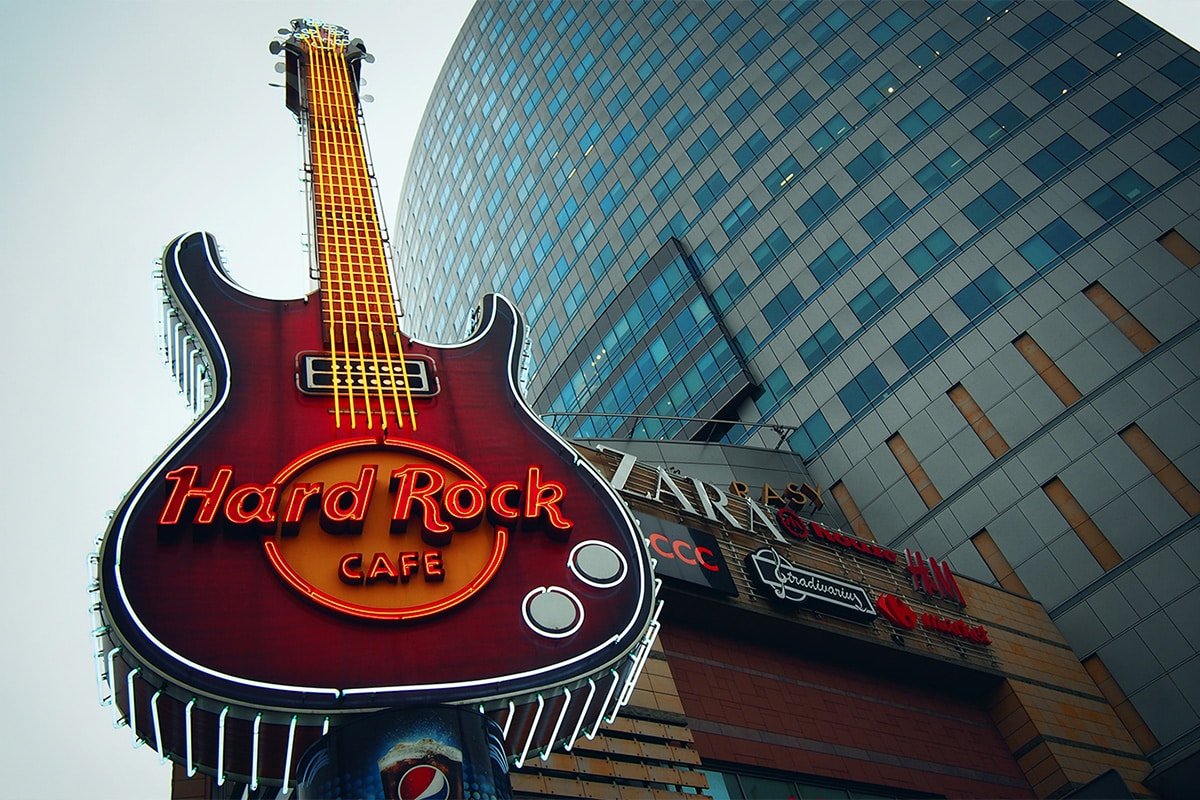
In the wreckage of the theme restaurant era, one brand not only survived but thrived. Hard Rock Cafe (the original, the blueprint, the concept that everyone else was trying to replicate) now operates more than 270 cafes, hotels, casinos, and live music venues across 74 countries. The Seminole Tribe of Florida acquired the brand in 2007 and has expanded it aggressively ever since. It is, by almost any measure, one of the most globally recognized hospitality brands on earth.
The reasons Hard Rock survived when everything else collapsed are not accidental. From the beginning, Hard Rock was built on something more durable than celebrity novelty or elaborate theming. The memorabilia collection, started by Eric Clapton’s guitar and Pete Townshend’s competitive generosity, gave the brand genuine cultural substance. Walking into a Hard Rock was not just walking into a themed environment. It was walking into a living archive of rock and roll history, one that continued to grow and evolve as music itself evolved.
Hard Rock also diversified in ways that made strategic sense rather than just opportunistic ones. Hotels and casinos extended the brand into complementary hospitality categories where the rock and roll identity carried naturally. Live music venues gave the brand an ongoing, renewable cultural connection. There was always something happening, always a reason to come back that had nothing to do with whether you had already seen the memorabilia.
And crucially, Hard Rock cared about the food. Not in a Michelin-star way (the brand was never pretending to be something it was not), but in the fundamental sense that the burgers and the service were considered important rather than incidental. One of the original founders, Peter Morton, was explicit about this: great food and great service for the money were the foundation, and the memorabilia was the story built on top of that foundation. When the foundation is sound, the story can keep changing. When the foundation is novelty alone, the story ends the moment the novelty does.
What the Theme Restaurant Era Still Teaches Us
The theme restaurant boom and bust is not just a story about restaurants. It is a story about what happens when an industry mistakes a cultural moment for a permanent market condition, and builds as if the moment will never end.
The brands that rose fastest in the 1990s theme restaurant era shared a common flaw. They were built primarily around the experience of discovery rather than the experience of satisfaction. They were optimized for the first visit, not the hundredth. And in a business, any business, depending on repeat customers, that is a fatal miscalculation.
The celebrity dependency lesson is equally sharp. Borrowing someone else’s cultural equity to launch a brand can generate extraordinary early momentum. Planet Hollywood’s opening proved that definitively. But borrowed equity is not owned equity. The moment the celebrity stops being culturally relevant, or stops showing up, or the novelty of the association fades, the borrowed momentum disappears. What remains is whatever the brand built for itself in the meantime. For most of the 1990s theme restaurants, the answer was not enough.
Overexpansion killed what the market did not. This is the Starter jacket lesson, the AND1 lesson, and the lesson that recurs throughout brand history with such consistency that it should be treated as a law rather than a pattern: the fastest way to destroy something special is to make it available everywhere. Scarcity and exclusivity are not just marketing tactics, they are structural properties of certain brand identities. Remove them, and you remove the thing that made the brand worth having.
And Hard Rock’s survival teaches the most important lesson of all that substance outlasts spectacle. The memorabilia, the music, the food that was genuinely worth eating, the hotels and casinos that gave the brand new reasons to exist. These were not accessories to the Hard Rock identity. They were the identity. Everything else was packaging. When the packaging loses its novelty, the substance is what remains. For the brands that had nothing beneath the packaging, there was nothing left to save.
Key Takeaways
- Novelty drives the first visit. Substance drives every visit after that. Theme restaurants were world-class at generating first-time traffic and catastrophically bad at generating repeat customers. Any business built primarily around the experience of discovery rather than the experience of satisfaction faces the same structural problem.
- Borrowed equity is not owned equity. Celebrity association can generate extraordinary early momentum. But it is borrowed, not built. When the celebrity fades or the novelty wears off, what remains is whatever the brand built for itself. For most 1990s theme restaurants, that was not enough to sustain them.
- Overexpansion is how brands destroy what made them special. The Planet Hollywood that existed in three cities was a destination. The Planet Hollywood that existed in 87 cities was a chain. Scarcity and exclusivity are not just tactics, they are structural properties of certain brands that disappear the moment expansion ignores them.
- Theme park cost structures cannot survive on restaurant margins. Elaborate animatronics, celebrity licensing, rotating memorabilia, and theatrical decor require revenue levels that only the highest-traffic tourist locations can sustain. The brands that expanded beyond those locations discovered the math did not work.
- Substance outlasts spectacle. Every time. Hard Rock survived because it had something real underneath the experience in genuine memorabilia, good food, and an identity rooted in music that could keep growing as music grew. The brands that had nothing beneath the spectacle had nothing to fall back on when the spectacle faded.
FAQs About Theme Restaurants
What happened to Planet Hollywood?
Planet Hollywood filed for Chapter 11 bankruptcy in October 1999 after accumulating $359 million in debt and recording massive losses as its aggressive expansion plan collapsed. It exited bankruptcy in 2000, closed most of its locations, and filed for bankruptcy a second time in subsequent years. Today, fewer than 10 Planet Hollywood locations remain worldwide (primarily in Florida, New York, and a small number of international markets) where the brand survives as a tourist attraction rather than the cultural phenomenon it was at its 1990s peak.
Why did Hard Rock Cafe survive when other theme restaurants failed?
Hard Rock survived for several interconnected reasons. Its memorabilia collection, one of the most valuable archives of rock and roll history in existence, gave the brand genuine cultural substance that continued to grow and evolve rather than aging in place. Its diversification into hotels, casinos, and live music venues was strategically coherent, extending the brand into complementary categories where the rock and roll identity carried naturally. And from the beginning, Hard Rock’s founders treated the food and service as foundational rather than incidental. The experience was built on top of a functional restaurant, not instead of one. When the Seminole Tribe of Florida acquired the brand in 2007, they inherited something that had been built to last.
What marketing lessons can small businesses take from the theme restaurant era?
Three lessons translate directly. First, build your brand on something you own rather than something you borrow. Celebrity associations, viral moments, and cultural trends can launch a brand, but they cannot sustain one. Second, be cautious about growth that dilutes what makes you special. The neighborhood restaurant that everyone talks about loses something important when it becomes a chain. Third, and most importantly, the product has to be genuinely good. No amount of atmosphere, memorabilia, celebrity backing, or brand identity can substitute for a product or service that gives customers a real reason to come back. The theme restaurants that failed forgot that. The one that survived never did.
At Resolution Promotions, we believe the strongest brands are built on something real. Not borrowed equity or manufactured excitement, but genuine value that gives customers a reason to keep coming back. If you are ready to build that kind of brand, let’s talk.